 Illustrated with AI
Cybersecurity for Juniors · Book 1 · Chapter 2
The Message From "Bank Manager Uncle"
Part 1. An urgent message
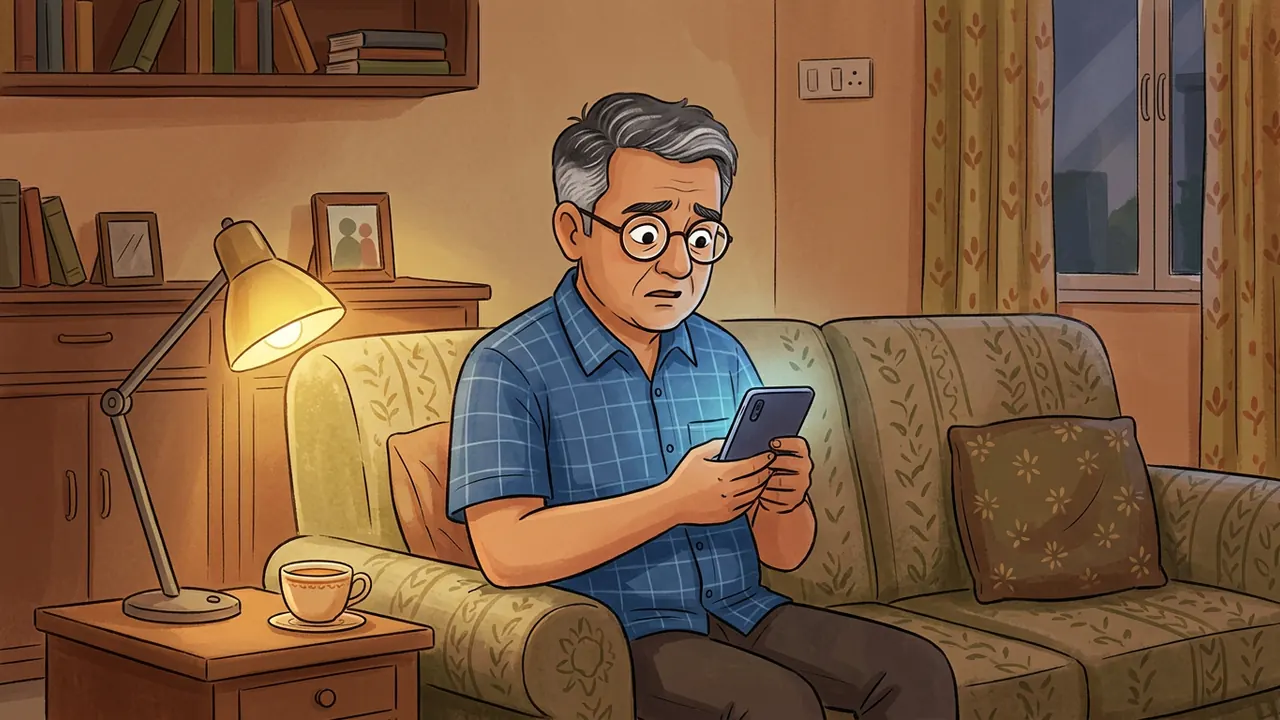
It was a quiet Tuesday night, and Ranjan uncle was alone in his living room, finishing his tea, when his phone buzzed. A message. He picked it up and read it twice, and the second time his stomach dropped a little.
"Dear Customer, your SBI KYC will EXPIRE TODAY. Update immediately or your account will be BLOCKED within 2 hours. Click now to verify: sbi-kyc-verify-online.in"
Ranjan uncle was not a man who liked surprises, and he liked the word "blocked" even less. His whole pension came into that account. He sat up straight, found his glasses, and started typing the link into his phone.
Part 2. Bunny notices something odd
Just then, the doorbell rang. Bunny had come to drop off the new society chore register, with Riya trailing behind him to collect a book she'd lent Ranjan uncle weeks ago. They found him hunched over his phone, thumb hovering, looking pale.
"Uncle, what's wrong?" asked Bunny.
Ranjan uncle showed them the message. Riya read it once and frowned. "Who's it from?" she asked, and tapped the sender name. It wasn't a saved contact. It wasn't even a bank's usual short code. It said, simply, VM-SBIKYC.
"That's not how the real bank sends messages," said Bunny slowly. "And look at this link. It says sbi, but it's not actually the bank's website. It's a completely different address that just looks similar."
Ranjan uncle looked at the clock. 11:47 PM. "But it says two hours," he said, his thumb still hovering over the link. "What if it's real?"
Part 3. The phone call
 Illustrated with AI
Before anyone could answer, the phone rang. Ranjan uncle answered it, hands shaking slightly, and put it on speaker so the kids could hear too.
"Namaste sir," said a smooth, friendly voice. "Main aapke bank se bol raha hoon, aap mujhe Bank Manager Uncle bol sakte hain. Aapka KYC turant update karna hai, warna account block ho jayega. Bas ek chhota sa OTP bata dijiye, sir, bas do minute ka kaam hai."
The voice was patient and polite and called him sir again and again, the way a man who truly respected him would. "Please sir, time kam hai," it added. "Aapka OTP aane wala hai, jaise hi aaye, bol dijiye."
Ranjan uncle, who had spent a lifetime believing that polite people were trustworthy people, began to nod along. "Haan, theek hai," he started to say.
Part 4. Mitthu almost makes the same mistake
 Illustrated with AI
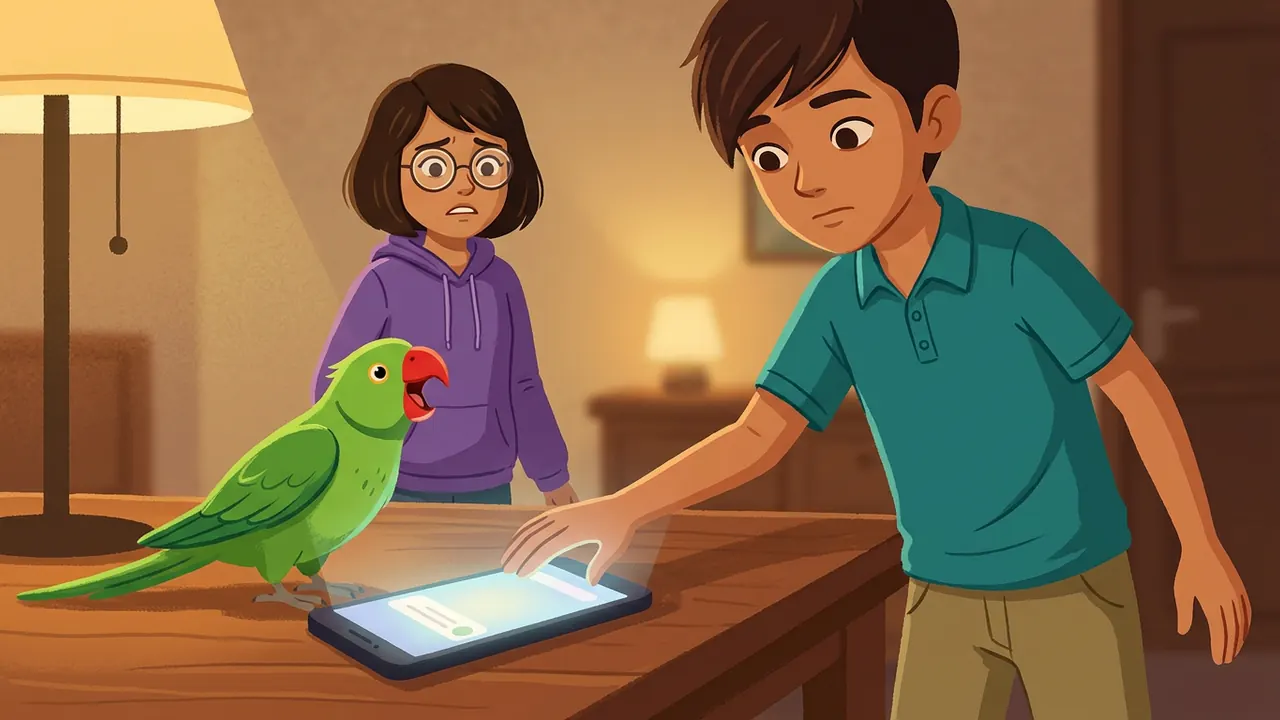
Right then, an SMS landed on the phone, sitting face up on the table. "Your OTP is 7294. Do not share this with anyone, including bank staff." Mitthu, who had flown in through the balcony door a minute earlier and perched himself right next to the phone, tilted his head, read it, and opened his beak out of pure habit.
"Seven! Two! Nine," he began, exactly the way he'd read Mrs. Iyer's password out loud a week ago.
And then he stopped. Just like that, mid-word, as if something had clicked. He closed his beak, ruffled his feathers, and said instead, very primly, "Can't tell you. Private information."
Bunny didn't wait to see if the moment would last. He lunged for the phone and ended the call, right in the middle of "Sir, bataiye".
The living room went quiet. Ranjan uncle stared at the blank screen, then at Mitthu, then at Bunny. "Did I almost..." he started.
"Yes," said Riya gently. "You almost did."
Part 5. Nilu chachu explains
 Illustrated with AI
Bunny called Nilu chachu, who arrived within the hour, still in his kurta, carrying his laptop out of habit. He read the message, listened to Ranjan uncle describe the call, and nodded slowly.
"This is called phishing," he said. "Spelled with a ph, as a little joke on the word fishing. Someone casts out a message to thousands of phones at once, baits it with fear or urgency, and waits for a few people to bite. The phone call is the same trick with a human voice attached, and that one even has its own name: social engineering. It means tricking a person directly, instead of tricking a computer."
"But he sounded so sure," said Ranjan uncle. "He even called it correctly, Bank Manager."
"Of course he did," said Nilu chachu. "He can call himself anything he likes. A caller ID can even be faked to show a bank's real name, a trick called spoofing. None of that is proof of anything. Here's the one rule that never changes: a real bank, a real government office, a real anyone, will never, ever ask you to tell them your OTP over a call or a message. An OTP exists so that only you can approve something, using your own phone, in your own banking app. The moment someone else asks for it, the whole idea has already failed."
"Then what should I have done?" asked Ranjan uncle.
"Hung up," said chachu. "And if you were ever unsure, called the number printed on the back of your own card, not any number from the message. Never the one they give you. Always the one you already trust."
Part 6. Reporting it
Together, they blocked the number, and Nilu chachu showed Ranjan uncle how to report the message through Chakshu on the Sanchar Saathi portal, sancharsaathi.gov.in. He also told him about 1930, India's cybercrime helpline, and cybercrime.gov.in, for whenever money has actually been sent.
Then Ranjan uncle, in a move that surprised everyone a little, opened the Silverline Heights WhatsApp group and typed, slowly and with great care, a warning to the whole building. He read it aloud before sending, the way he always did. "Do not share it anywhere it can be seen," he murmured, and then laughed at himself for saying it, because that was exactly the lesson from last time too.
Part 7. A lesson that sticks
 Illustrated with AI
Later that night, Ranjan uncle sat on the balcony with a fresh cup of tea, Mitthu perched companionably on the railing beside him.
"You caught yourself," Ranjan uncle said to the parrot. "Last week you'd have read that whole number out before anyone could stop you."
Mitthu considered this with great dignity. "I am a quick learner," he said, "for a parrot who nearly wasn't."
Ranjan uncle laughed, properly, for the first time all evening.
Moral of the story
A real bank will never ask for your OTP. If a message or a call makes you feel rushed, that feeling is the warning, not a reason to hurry.
A voice may sound as kind as kin,
and still be fishing, hook within.
Slow your hand, and check it twice,
for haste is where they bait their price.
Spot the red flags
The Message on Ranjan Uncle's Phone
From: VM-SBIKYC 1
"Dear Customer, 2your SBI KYC will EXPIRE TODAY. Update immediately or your account will be BLOCKED within 2 hours. 3Click now to verify: sbi-kyc-verify-online.in" 4
Received 11:47 PM, from a 10-digit mobile number. 5
The sender is a jumble of letters, not a saved contact and not the bank's real registered short code.
"Dear Customer" instead of an actual name. A bank that already has your KYC details usually knows who you are.
A countdown and a threat, built to make you panic and act fast instead of stopping to think.
A link that looks close to the real thing but isn't, a trick called typosquatting.
It arrived at midnight. Banks don't usually send urgent account deadlines while everyone is asleep.
Mitthu's notebook
What really happened?
| In the story | The real idea |
|---|---|
| The KYC message sent to Ranjan uncle's phone | Phishing: a fake message, sent widely, designed to look official and trustworthy |
| "Bank Manager Uncle" on the phone, asking politely | Social engineering: tricking a person directly, using trust and good manners as the weapon |
| "Your account will be BLOCKED in 2 hours" | An urgency tactic: fear and a countdown, built to stop you thinking clearly |
| The caller introducing himself as being from the bank | Spoofing: a name, number or caller ID can be faked, so it is never proof by itself |
| sbi-kyc-verify-online.in | Typosquatting: a web address built to look like the real one at a glance |
| "Just tell me the OTP, sir" | OTP fraud: the single most common way Indian bank accounts actually get emptied |
| Mitthu catching himself before reading the OTP aloud | The same shoulder-surfing risk from Chapter 1, this time with a one-time code instead of a password |
| Reporting on cybercrime.gov.in and calling 1930 | India's official channels for reporting cyber fraud |
Try it yourself
Real message, or scam?
Here are six messages. Read each one and decide: would you trust it, or is something off?
Maths corner
Why scammers don't need to fool everyone
Imagine a scammer sends the same fake message to 100,000 phone numbers. It costs them almost nothing to send that many. Now suppose only a tiny fraction of people fall for it, say 0.5 out of every 100, which we write as 0.5%, or 0.005 as a decimal.
100,000 × 0.005 = 500 people. Five hundred people, from one message, sent once.
Your turn. If a scammer sends 1,000,000 messages, and only 0.1% of people fall for it, how many victims is that?
Answer: 1,000,000 × 0.001 = 1,000 people. That's why scammers play a numbers game instead of trying to be clever with any one person. They don't need to fool you. They just need to send enough messages that someone, somewhere, is tired, distracted or worried enough to click.
Try it on a computer · optional
A tiny link checker in Python
# a very simple check, real browsers do far more than this
trusted = ["onlinesbi.sbi.co.in", "hdfcbank.com", "icicibank.com"]

link = input("Paste the link: ")
domain = link.split("/")[2] if "//" in link else link

if domain in trusted:
    print("This domain is on the trusted list.")
else:
    print("Stop. This domain is not on the trusted list.")
Paste the link: https://sbi-kyc-verify-online.in/update
Stop. This domain is not on the trusted list.
Run this in any free online Python editor, and try it with "https://onlinesbi.sbi.co.in/login" too. A real browser does something similar automatically, checking a link against huge, constantly updated lists of known scam sites, which is one reason it's safer to type an address yourself than to click a link in a message.
Security tip
The one rule that covers almost everything
No bank, no government office, and no genuine company will ever ask you to say or type your OTP to them, on a call, in a message, or in a chat. If anyone asks, the conversation is already over. Hang up, do not click the link, and if you want to check whether something is really wrong with an account, call the number printed on your own card or open the official app yourself. Never use a number or a link that the message gave you.
Did you know?
Fun facts
Myth or fact?
"If the caller ID shows my bank's name, it really is my bank calling."
MythCaller ID, and even the sender name on a message, can be faked to display almost anything, including a real bank's name. It is a convenience feature, not a security check, and it should never be the reason you trust a call.
Try this · no computer needed
The red flag hunt
You need: five or six printed messages (a mix of real notices and made-up scams, prepared ahead by a teacher or parent), and a pen.
- In pairs, read each message and circle anything that feels like a red flag: urgency, a generic greeting, a strange sender, a request for a code, an offer that sounds too good.
- For each message, decide together: trust it, or be suspicious of it?
- Compare answers as a class. Which red flags did almost everyone spot? Which ones were easy to miss?
- Now try writing your own fake scam message, using at least three red flags on purpose. Trade with another pair and see if they can find all three.
Careers corner
Fraud analyst
A fraud analyst works inside a bank or a company's security team, watching for exactly this kind of pattern: unusual transactions, suspicious logins, and scam messages reported by customers. Part detective, part data analyst, their job is to notice what doesn't fit, and to help build the systems that catch it automatically next time.
Useful to learn: noticing small inconsistencies, working comfortably with numbers and data, staying calm under pressure, and explaining what you've found clearly to someone who isn't a technical expert.
Quiz time
How well did you learn?
Think and discuss
No wrong answers here
- Ranjan uncle had just learned a security lesson in Chapter 1, and he still almost fell for this scam. Does learning one lesson protect you from every kind of trick? Why not?
- Why do you think scammers are so polite, and call people "sir" or "madam" again and again?
- If a message or a call ever makes you feel rushed or scared, what is one simple thing you could do to slow yourself down?
- Ranjan uncle warned the whole building WhatsApp group afterward. Who would you tell first, if something like this happened to you or your family?
Be curious
Ask a teacher, parent or engineer
Word bank
New words from this chapter
Coming up in Chapter 3
Happy finds a new game, and it only wants a little bit of access to play: your contacts, your camera, your location, your photos. Just this once. Just to unlock the fun level. What could a game possibly want with all of that?
For teachers and parents: this chapter fits two 40-minute periods. Period 1: read Parts 1 to 7 aloud (15 min), the "Spot the red flags" message panel together (10 min), then the Maths corner (10 min). Period 2: the "Real message, or scam?" interactive, the red flag hunt activity, and the quiz. The key ideas: no genuine bank, government office or company ever asks for your OTP over a call or message; urgency and politeness are both manipulation tools, not signs of trustworthiness; caller ID and sender names can be faked; and the safest response to any unexpected urgent message is to slow down and verify independently, using a number or app you already trust, never one the message itself provides. The Python corner is optional. All chapter illustrations are AI-generated scene art; the message panel, game and diagrams were built by hand.