Stay safe from scams
AI makes scams sound and look more real than ever: cloned voices, fake videos of famous people, perfect messages in any language. Here is how each common scam in India works, the red flags, and exactly what to do.
Scams to know
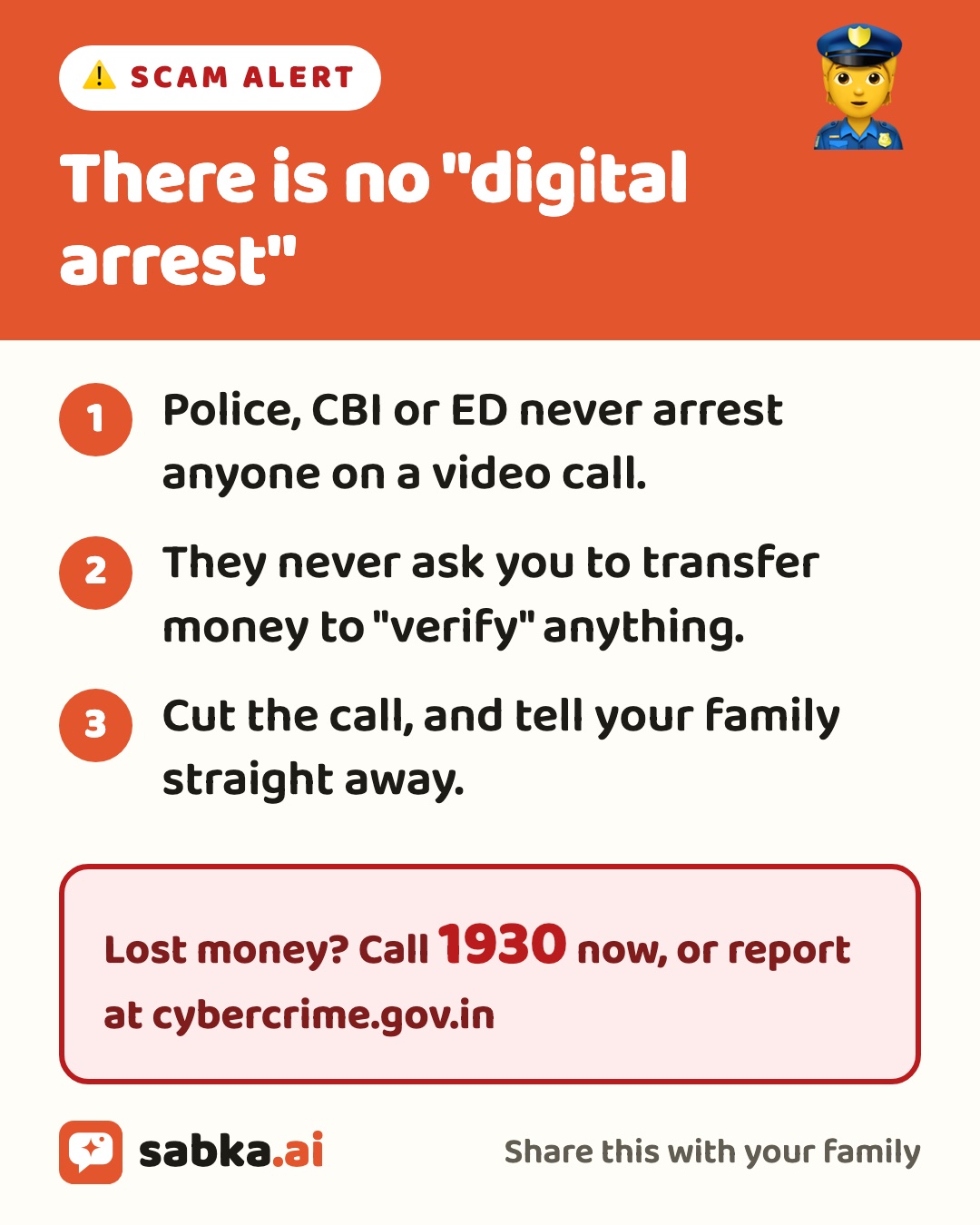
Share these with your family- Digital arrest scamFake police, CBI or ED officers on a video call say you're under arrest and must pay. There is no such thing.
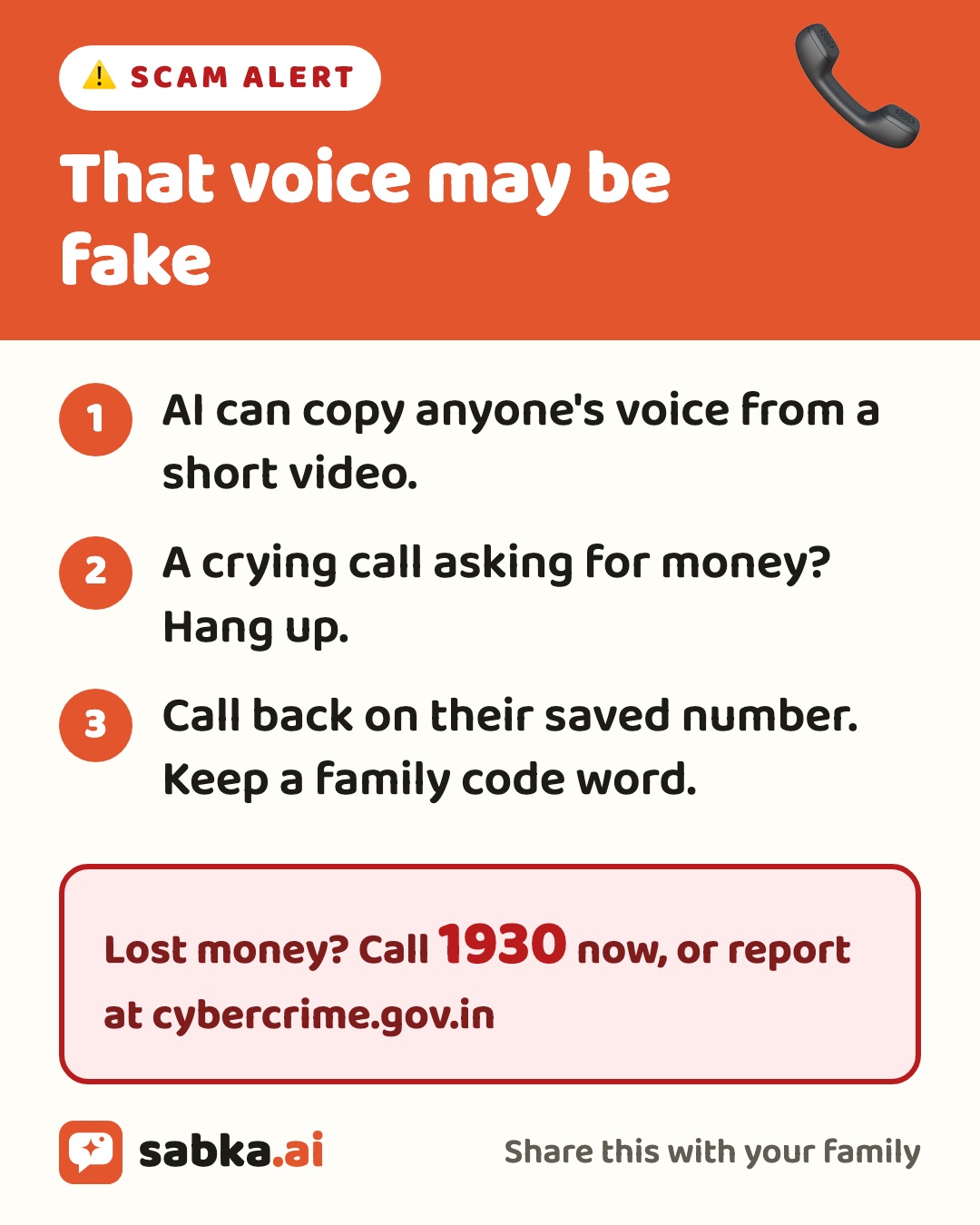
- Cloned voice of a family member"Mummy, I've had an accident, send money now!" AI can copy a voice from a short clip. Hang up and call back.
- Deepfake celebrity investment adsA famous face "recommends" a stock tip or trading app with guaranteed returns. The video is fake.
- Fake KYC update and OTP fraud"Your KYC expires today, your account will be blocked." Banks never ask for your OTP, PIN or password.
- UPI PIN and QR code scams"Scan this QR to receive money." You never need your UPI PIN to receive money, only to pay.
- Part-time job and "task" scamsEarn ₹5,000 a day liking videos or rating hotels? They pay you small amounts first, then take your deposits.
- Sextortion and morphed photosA stranger records a video call or makes a fake nude with AI, then threatens to share it. Don't pay. Get help.
- Fake customer-care numbersYou search online for a helpline, call it, and the "agent" asks you to install an app or share a PIN for your refund.
- Fake wedding invites and APK filesA "wedding card", "bill" or "bank update" arrives as an .apk file on WhatsApp. Installing it hands over your phone.
- Fake AI apps and chatbot clonesLook-alike "ChatGPT" or "AI photo" apps that charge big subscriptions, steal data or carry malware.
- Illegal instant loan appsQuick loans with no checks, then huge charges, threats and morphed photos sent to your contacts.
- Fake trading apps and stock-tip groups"VIP" WhatsApp or Telegram groups promise insider tips and IPO quotas, then trap you in a fake trading app.
- Gift card scamsA "boss", official or relative asks you to buy gift cards and send the codes. Once they have the code, the money is gone.
- Shopping account takeoverSomeone gets into your shopping or wallet app and spends your gift card balance, coins and saved cards.
- Fake delivery and parcel scams"Your parcel couldn't be delivered. Pay ₹25 to reschedule." The link steals your card details and OTP.
- Money mule accounts"Earn commission just by letting us use your bank account." Your account is then used to move scam money, and police come to you.
- Unknown charges on your card or accountA debit you didn't make? Report it to your bank within 3 working days. Under RBI rules you usually don't pay for it.
- SIM swap and eSIM fraudYour phone suddenly loses signal. Someone has moved your number to their SIM and is reading your bank OTPs.
- Aadhaar fingerprint (AePS) fraudMoney withdrawn using your Aadhaar number and a copied fingerprint, with no OTP. Lock your biometrics to stop it.
- Fake traffic challan and bill messages"Your challan is pending, pay now" or "Electricity will be cut tonight." The link or app steals your OTPs and money.
- Fake travel, pilgrimage and hotel bookingsKedarnath helicopter, Char Dham or hotel booked on a fake site. You pay, and no ticket or room exists.
- Fake "army officer" buyer and rental scamsA "soldier" being transferred sells a cheap bike, or wants to rent your flat, then asks you to send money "to receive" payment.
- Matrimonial and romance scamsA perfect match online, often an "NRI" or officer, who soon needs money for customs, visas or an emergency.
- Fake jobs abroad and scam compoundsA well-paid "data entry" or IT job in Thailand or Dubai turns into forced scam work in Myanmar, Cambodia or Laos.
- Fake shopping sites and sale linksAn iPhone for ₹999 in a "Big Billion" sale link. The site is a copy, and your card details go to scammers.
- Loans and SIMs taken in your nameRecovery calls for a loan you never took, or SIMs you never bought. Someone is using your PAN and Aadhaar.
Posters to share
All 13 posters, English and Hindi →Send one to your family WhatsApp group, or print it for a school, office or society noticeboard.
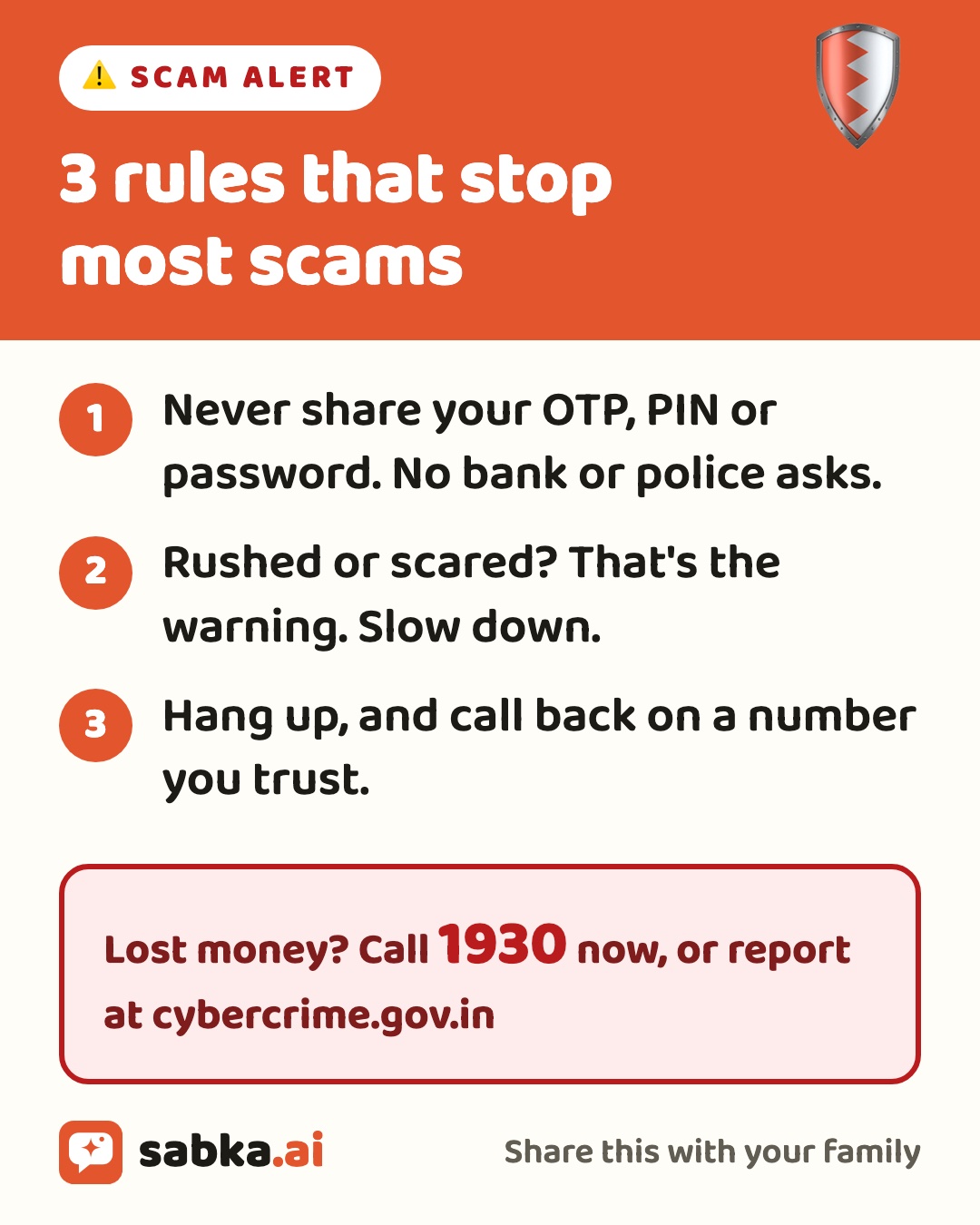

Three rules that stop most scams
- Never share an OTP, PIN or password. No bank, police officer or company will ever ask for one.
- Urgency is the warning. "Right now", "or you'll be arrested", "offer ends in 2 minutes": slow down and check.
- Hang up and call back on a number you already trust: the one on your card, the official app, or the family member's saved number.
For children: learn it through stories
Cybersecurity for Juniors →Strong passwords, PINs and 2FA
Why a password built from public information is no lock at all, and how passphrases, password managers and two-factor authentication keep accounts safe.
5-minute read · Chapter 1
Real banks never ask for your OTP
How fake KYC messages and "bank manager" calls trick people into sharing OTPs, the red flags to spot, and where to report in India.
5-minute read · Chapter 2
Apps that ask for too much
Why a game doesn't need your camera or contacts, how "Allow All" buttons push you, and why game gems are real money.
5-minute read · Chapter 3
Small posts, big picture: oversharing online
How harmless posts add up to reveal where you live, study and go, and how privacy settings and one simple question keep you safe.
5-minute read · Chapter 4
Fake prizes, popups and malware
Why "you are our millionth visitor" is always a trick, how fake popups install malware, and what to do if your phone starts acting strange.
5-minute read · Chapter 5
Forwarding hurts too: cyberbullying
Why forwarding or repeating a mean joke still spreads harm, how screenshots outlive deletions, and what to do instead.
5-minute read · Chapter 6
Free wifi traps and the padlock
How fake "evil twin" wifi networks work, what the padlock and HTTPS mean, and what to do before typing a password in public.
5-minute read · Chapter 7
A real photo, a fake story: checking forwards
How true photos are paired with false captions, the two questions to ask before forwarding, and why corrections travel slower than rumours.
5-minute read · Chapter 8
Ransomware and the 3-2-1 backup rule
How a fake bill attachment can lock your files, why you should never pay a ransom, and the simple backup rule that saves the day.
5-minute read · Chapter 9
Cyber Squad: safety habits for the whole family
How one person's weak habit puts everyone at risk, and simple safety habits families and neighbours can share.
5-minute read · Chapter 10
Test yourself
Where to report in India
- Cybercrime helpline 1930Money has been taken or a payment was tricked out of you. Call at once: the sooner, the better the chance of freezing it.Call 1930
- National Cyber Crime Reporting PortalFile a complaint about any cyber fraud, harassment, sextortion or morphed images.cybercrime.gov.in
- Chakshu, on Sanchar SaathiReport a suspected fraud call, SMS or WhatsApp message, even if you lost nothing.sancharsaathi.gov.in
- Your bank, directlyBlock your card or UPI, and report the transaction. Use the number on your card or the bank's official app, never one from a message.Number on your card
- The app or platformReport and block the account on WhatsApp, Instagram, YouTube or wherever it happened, so it can be taken down.Report in the app
- Local police or cyber cellFor threats, blackmail or large losses, file an FIR. Take your screenshots and transaction details.Emergency: 112
- Childline 1098A child is being bullied, threatened or harmed online. Free, 24 hours.Call 1098
- RBI SachetReport an illegal loan app or a company collecting money without permission.sachet.rbi.org.in
- SEBI registration checkCheck whether an investment adviser or broker is really registered before you pay anyone.sebi.gov.in