 Illustrated with AI
Jugnupur Tales · Volume 2 · Chapter 1
The Society Committee Vote
Part 1 · Back in the city
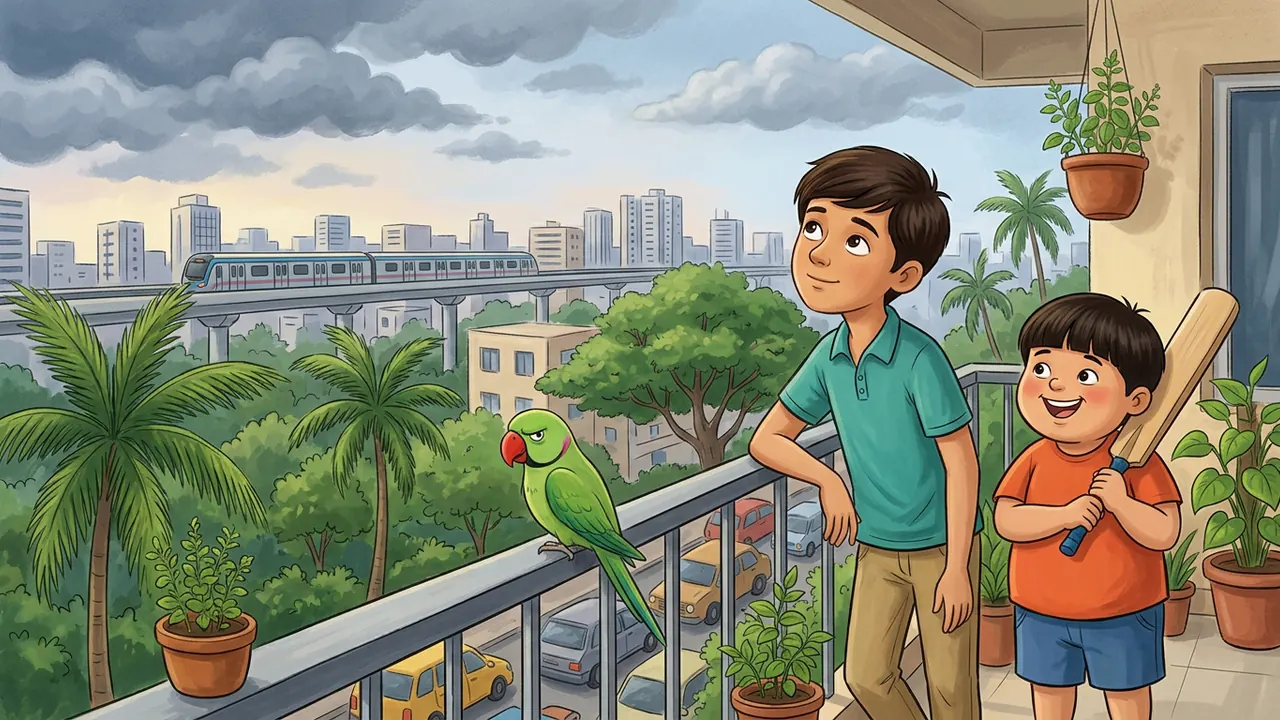
The summer holidays were over. The mangoes of Jugnupur had been eaten, the fireflies had been waved goodbye, and Bunny and Happy were back home in Bengaluru, on the twentieth floor of Silverline Heights in HSR Layout, Sector 1.
Bunny was thirteen now, and starting Class 8. Happy was nine, and just as full of schemes as ever. And this year, for the first time, someone else had come home with them: Mitthu. Dadi had said the old parrot needed “a little city education”, and Mitthu had agreed, on one condition. He would have the best spot on the balcony railing.
He had not expected the traffic. “Honk, honk, HONK!” he grumbled, glaring down at the jam on the main road. “In Jugnupur, the only thing that honks is a goose. And even the goose has manners.”
But at Silverline Heights, nobody was thinking about traffic. They were thinking about Sunday. Every Sunday morning, Block A played Block B at cricket on the society ground, and every Saturday night, the whole society argued about whether the match should happen at all.
Part 2 · Everyone talks at once
 Illustrated with AI
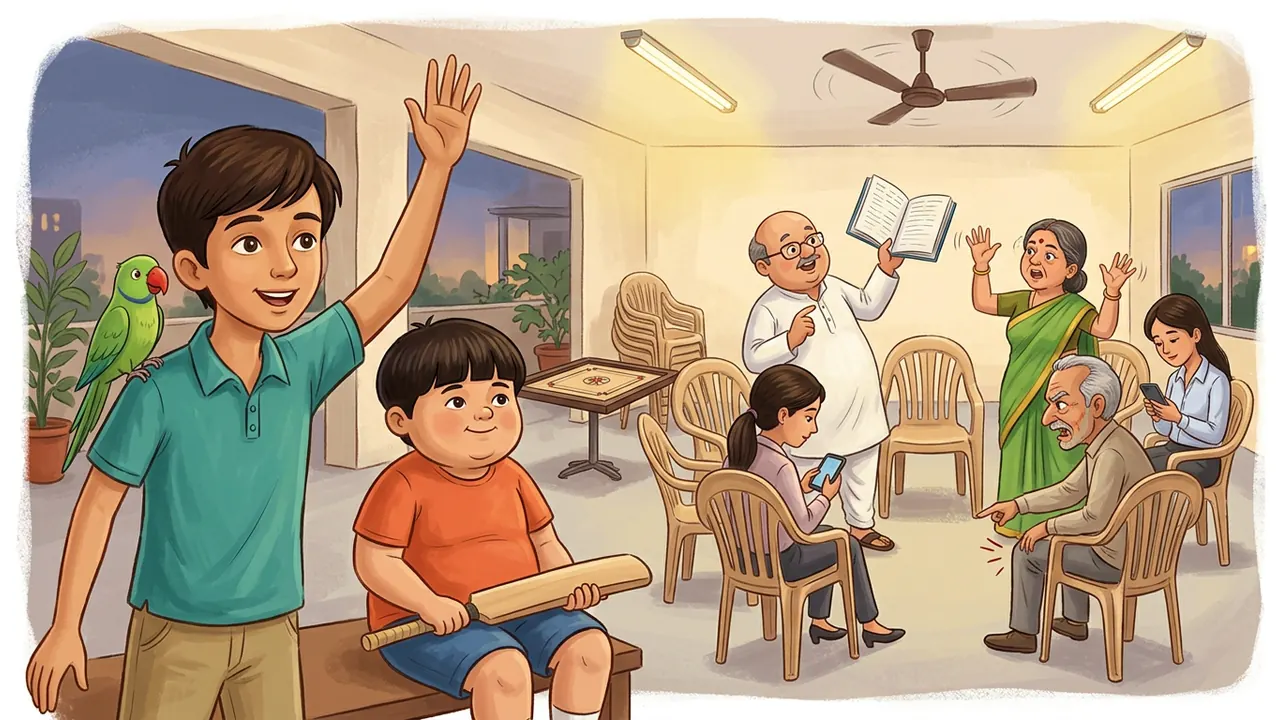
That Saturday, the society committee met in the clubhouse. Prakash uncle, the secretary, opened his fat notebook. “The question,” he announced, “is Sunday’s match. Yes or no?”
Everyone answered at once.
“Look at those clouds!” said Jyoti aunty. “It will pour.”
“The weather app says only a small chance,” said Anjali didi from the fourth floor, without looking up from her phone.
“My knee is aching,” said Gowda thatha darkly. “My knee is never wrong.”
“It rained on Thursday, the ground is still soggy,” said Bharath anna, the security guard, who kept the key to the ground.
“Half of Block B has a maths test on Monday,” said somebody’s mother.
Prakash uncle looked at the ceiling fan as if it might help. “Every week, the same fight,” he sighed.
Happy jumped up. “Let Mitthu decide!”
Mitthu puffed out his chest. “Mango,” he said. Nobody was sure if that meant yes or no.
Then Bunny put up his hand. “Uncle,” he said, “everyone here is right about something. The clouds matter. The ground matters. The test matters. But they don’t all matter the same amount. What if every clue gets a vote, and the important clues get a bigger vote?”
Part 3 · The paper neuron
 Illustrated with AI
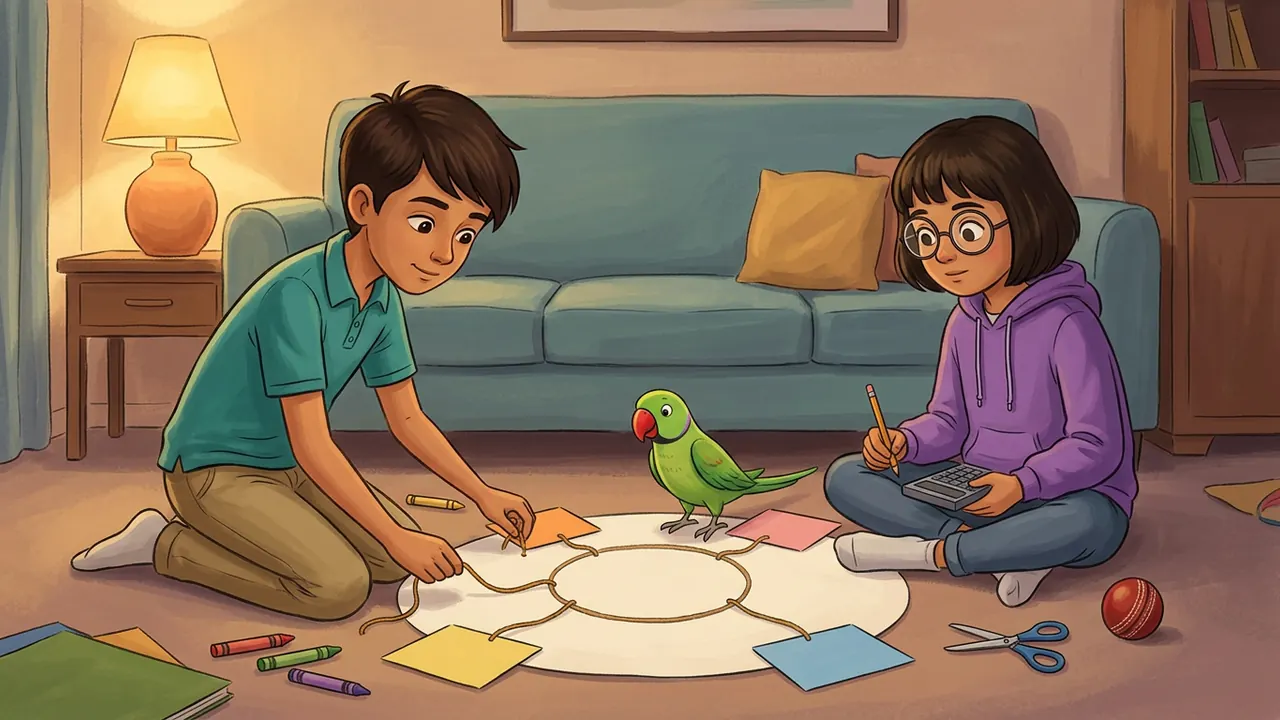
That night, Bunny spread paper all over the living room floor. Helping him was Riya from Block B, the other team’s captain, who wrote computer programs for fun and carried a calculator everywhere, “just in case”.
They made five cards, one for each clue. Each clue got a score from 0 to 1: a clear sky was 1 and black clouds were 0, a dry ground was 1 and a swamp was 0, and so on.
Then they gave each clue a weight: a number saying how much that clue should count. The ground got the biggest weight, 4, because nobody can play on a swamp. The clear sky got 3. Enough players got 2. Exam week got minus 5, because a test pushes hard towards “no”. And Gowda thatha’s knee got minus 1.
“Only minus one?” said Riya, grinning. “He’ll be offended.”
“It’s a good knee,” said Bunny. “But it isn’t a weather satellite.”
Last came the rule. Multiply each clue by its weight, add everything up, and if the total is more than 5, the match is on.
Mitthu hopped up beside the big paper circle as if he had invented it. “So the circle listens to everyone,” he said slowly, “but it listens to some more than others.”
“Exactly,” said Bunny. “Like a panchayat where the wisest people get more say.”
Bunny’s paper neuron
Each clue is multiplied by its weight. Green weights push towards “play”, red weights push towards “no match”.
Part 4 · Saturday night’s answer
Riya read out the numbers for this Saturday. The sky was mostly cloudy, so the sky clue was 0.2. The ground was half dry: 0.5. Gowda thatha’s knee was definitely aching: 1. No exam this week for Block A: 0. And there were plenty of players: 1.
“No match,” said Riya. She tried last Sunday’s numbers too, when the sky was blue and the ground bone-dry. “Nine. Play. That’s what really happened!”
Mitthu looked at the paper circle with new respect. “It’s like a very small, very fair brain,” he said.
Part 5 · Happy’s secret card
 Illustrated with AI
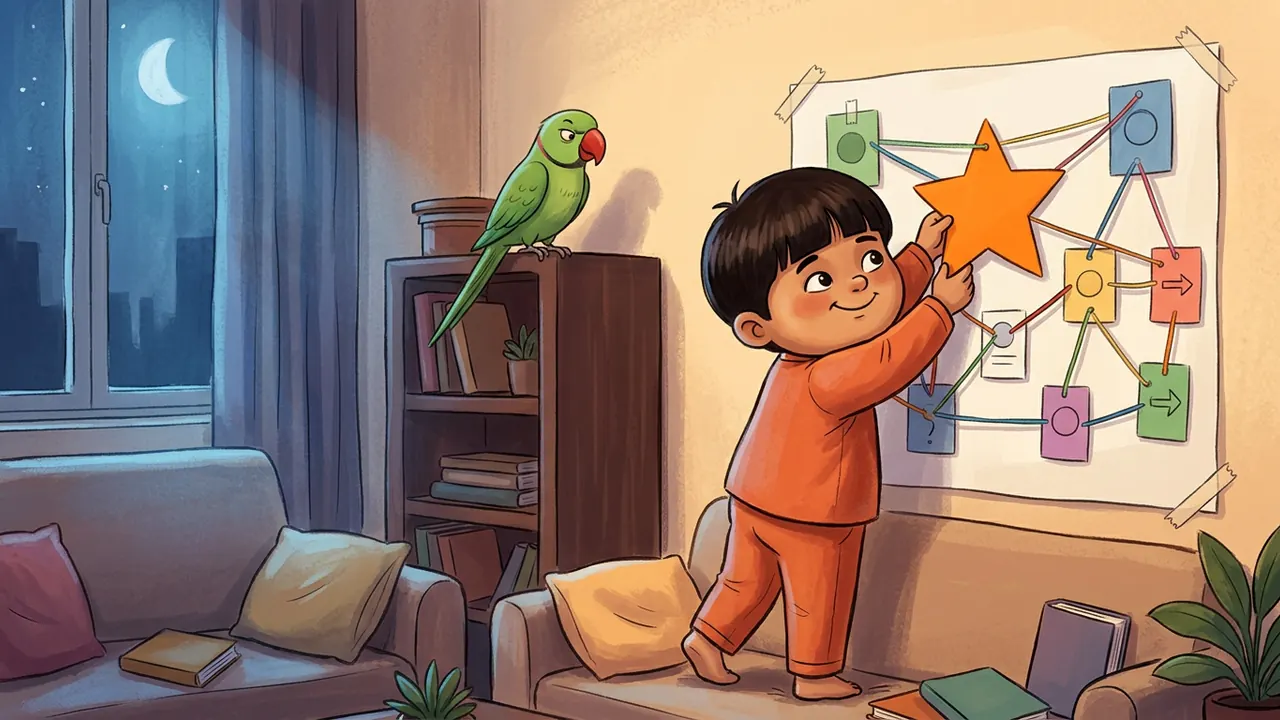
The paper neuron was taped to the living room wall. Happy looked at it for a long time. He did not like the answer. He wanted to play.
So, late that night, when everyone was asleep, he tiptoed out with a big orange star. It was a brand-new clue, Happy really wants to play, and on the back he had given it a weight of +100. He stuck it on the wall and joined it to the circle with a piece of string.
Mitthu watched the whole thing from the top of the bookshelf.
In the morning, Bunny did the sum again, just to be sure. “103.6?” he said. “That’s impossible. The sky is black!” Then he saw the star. “HAPPY!”
“I only added one card,” said Happy.
“One card with a weight of a hundred,” said Riya, “beats every other clue put together. Now it would say ‘play’ even in a cyclone.”
Bunny took the star down. “If someone can secretly change the weights,” he said, “they can change every answer, and nobody would even know.” From that day on, the paper neuron was kept inside Prakash uncle’s notebook, and only the committee could change it, together.
Part 6 · Kabir chachu counts the neurons
On Sunday morning, Kabir chachu came over for breakfast. He lived in Bengaluru too, on the other side of the city, and he built AI for a living. Bunny showed him the paper neuron.
Chachu laughed out loud. “Bunny, you’ve built an artificial neuron! That is the little building block of every neural network, the kind of AI that recognises faces, understands speech and writes answers in chatbots.”
“Just one circle?” asked Bunny.
“Real neural networks have thousands, millions, even billions of them,” said chachu. “They are arranged in layers. Remember how a photo is really just numbers for tiny coloured squares? Give those numbers to the first layer. Each neuron there looks for something small, like an edge or a curve. The next layer combines those into shapes, like an eye or an ear. The next combines shapes into a face. Every neuron is doing exactly what yours does: multiply, add, decide.”
Neurons in layers
Every line is a weight. This drawing has 31 of them. A big AI model can have billions.
“But who chooses all those weights?” asked Riya. “We argued for an hour about just five.”
Chachu smiled. “Nobody chooses them by hand. The network learns them from examples. It guesses, checks how wrong it was, and nudges every weight a tiny bit. Again and again, millions of times.”
Prakash uncle, who had come to see the famous paper neuron, was listening from the door. He opened his notebook. “I have written down every Sunday for three years,” he said. “The weather, the ground, whether we played.”
Chachu’s eyes lit up. “Uncle, that notebook is training data.”
Part 7 · The rain came anyway
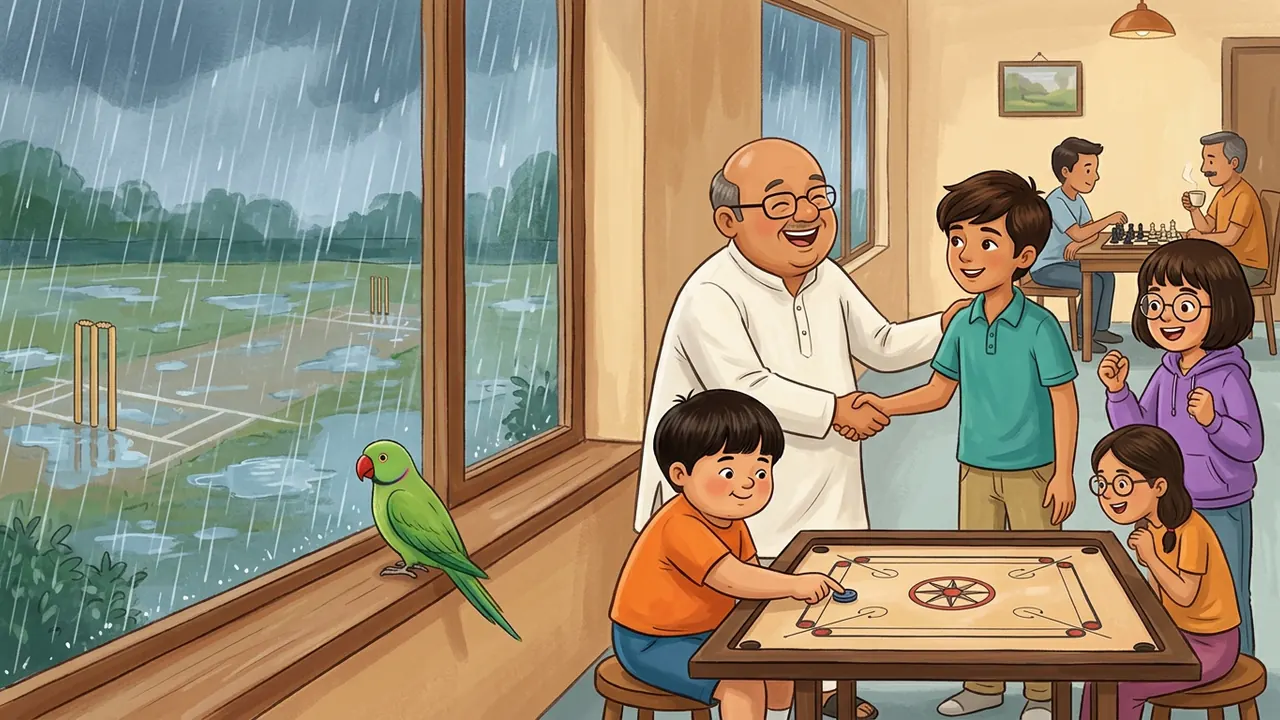 Illustrated with AI
At ten o’clock, the sky opened. Rain drummed on the clubhouse roof and turned the cricket ground into a small lake.
But nobody was standing in it, soaked and grumpy, because the committee had already decided the night before. Instead, Silverline Heights had its first ever Rainy Sunday Carrom Championship. Happy lost every game and didn’t mind at all.
Prakash uncle shook Bunny’s hand. “First time in three years,” he said, “that we decided in ten minutes, and nobody fought.”
Gowda thatha tapped his knee. “Minus one,” he muttered. “We will discuss this.”
And on the window sill, Mitthu watched the rain, feeling very pleased with the city after all. “A very small, very fair brain,” he said to himself. “I should get one.”
Moral of the story
Many small voices, weighed well, make a wise choice. But guard the weights, because whoever changes them changes the answer.
Each voice was heard, both loud and small,
but weighed with care, not equal all.
Keep safe the scale on which they lie,
and truth will come, however high.
Mitthu’s notebook
What really happened?
| In the story | In a real neural network |
|---|---|
| The five clues: sky, ground, knee, exam, players | Inputs: numbers going into a neuron |
| How much each clue counts (+4, −5…) | Weights: bigger number, bigger say; negative weights push towards “no” |
| “Multiply, add them up” | Weighted sum |
| “More than 5? Play!” | Threshold, or activation: turning the total into a decision |
| The paper circle | An artificial neuron |
| Chachu’s layers of circles | A neural network: neurons in layers, each layer passing its answers on to the next |
| Prakash uncle’s three-year notebook | Training data: examples the network learns its weights from |
| Happy’s secret +100 star | Tampering with a model: secretly changing its weights or inputs |
Try it yourself
Tune the paper neuron
Slide each clue between 0 and 1. The neuron multiplies, adds, and decides. Then tick Happy’s star and see what happens.
The red line is the threshold of 5. The total has to go past it for the match to be on.
Maths corner
The neuron in one line
If the clues are x₁, x₂, x₃… and their weights are w₁, w₂, w₃…, the neuron works out:
total = w₁x₁ + w₂x₂ + w₃x₃ + w₄x₄ + w₅x₅
and says “play” if the total is more than 5. That’s the same kind of sum as working out a weighted average for your marks, where the final exam counts more than a class test.
Your turn. A sunny day (sky 1), a dry ground (1), no knee pain (0), exam week (1), enough players (1). What is the total? Is the match on?
Answer: 3 + 4 + 0 − 5 + 2 = 4. That’s not more than 5, so no match. One big red weight can outvote a perfect sky.
Try it on a computer · optional
A neuron in six lines of Python
# the five clues, each from 0 to 1
clues   = [0.2, 0.5, 1, 0, 1]
# how much each clue counts
weights = [3, 4, -1, -5, 2]

total = sum(c * w for c, w in zip(clues, weights))
print(total, "Play!" if total > 5 else "No match")
3.6 No match
You can run this in any free online Python editor. Change the numbers and see the answer change. Then try adding Happy’s star: put a 1 at the end of clues and a 100 at the end of weights. In Scratch, you can build the same thing with five variables and one “if… then… else” block.
AI security tip
Guard the weights
Happy didn’t break the neuron. He just changed one weight and added one input, and the answer was his forever. Real AI systems face the same danger. That’s why engineers lock down who can change a model, keep a record of every change, and test the model again after each change to check that its answers still make sense.
Ask yourself: if an app makes decisions about you, who is allowed to change how it decides? How would anyone find out if someone did?
Did you know?
Fun facts
Myth or fact?
“A neural network works exactly like a human brain.”
MythArtificial neurons were inspired by brain cells, just as aeroplanes were inspired by birds. But a real neuron is a living cell that uses chemicals and electrical pulses, and scientists still don’t fully understand how the brain learns. An artificial neuron is just multiply, add and decide.
Try this · no computer needed
The human neuron
You need: 6 volunteers, chalk or paper, and one calculator.
- The class picks a question, like “Should we have PT outside today?”
- Five volunteers each become one clue (sky, ground, heat, time left, mood of the class) and hold up a score from 0 to 1.
- The class votes on a weight for each clue and writes it on the board. Argue about it! That’s the fun part.
- The sixth volunteer is the neuron: they multiply, add, and announce the decision.
- Now the teacher secretly changes one weight. Can the class work out which one, just from the strange answers?
Careers corner
Machine learning engineer
Machine learning engineers like Kabir chachu build and train neural networks. They collect and clean data, design the layers, train the model, test whether its answers are right and fair, and keep it running safely once people use it.
Useful to learn: maths (especially algebra, graphs and statistics), programming (Python is a common start), and plenty of curiosity about the problem you’re solving, whether that’s crops, health or cricket.
Quiz time
How well did you learn?
Think and discuss
No wrong answers here
- Who should get to decide the weights in a system that affects everyone, like the society’s match rule? Only experts, everyone, or a mix?
- Gowda thatha’s knee got a weight of −1. Was that fair? How could the committee find out how good his knee really is at predicting rain?
- Think of a decision in your life that depends on many clues, like choosing a school subject or a friend’s birthday gift. Which clues would get the biggest weights?
- Happy thought changing “just one card” was harmless. When is a small change not small at all?
Be curious
Ask a teacher, parent or engineer
Word bank
New words from this chapter
Coming up in Chapter 2
Prakash uncle’s notebook says the paper neuron would have got nine Sundays wrong in the last three years. How do you fix the weights without guessing? The answer is hiding in a thick morning fog on top of Nandi Hills…
For teachers and parents: this chapter fits two 40-minute periods. Period 1: read Parts 1–7 aloud (18 min), work through the paper neuron and the Saturday sum together (10 min), then the Maths corner (10 min). Period 2: “The human neuron” activity, the quiz, and the Think and Discuss questions. The key ideas: an artificial neuron multiplies inputs by weights, adds them and compares the total to a threshold; neural networks stack many neurons in layers; the weights are learned from training data rather than set by hand (Chapter 2 shows how); and whoever can change the weights controls the answers, so models must be protected from tampering. The Python corner is optional. The story illustrations marked “Illustrated with AI” were made with an AI image generator; the diagrams, tables and the neuron tuner were made by hand.