 Illustrated with AI
Jugnupur Tales · Volume 2 · Chapter 3
The Topper Who Only Memorised
Part 1 · The boy with the tower of papers
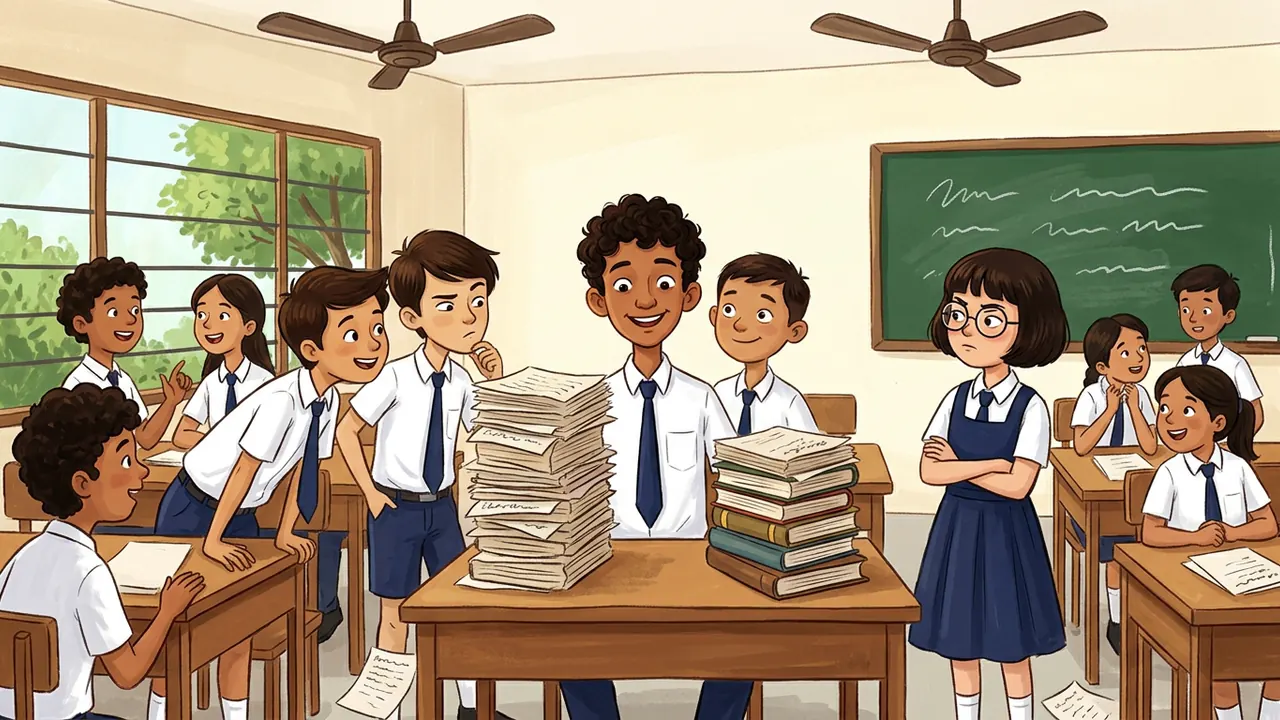
On the first Monday of term, a new boy walked into Class 8B carrying a stack of papers so tall that he had to peep around the side of it to find his desk.
“This is Arjun,” said Lakshmi ma’am, their class teacher, adjusting the spectacles that hung from a chain around her neck. “He’s joined us from Pune. Please make him welcome.”
Arjun put the tower down with a thump. “Question papers,” he explained. “The last five years of every subject. With all the answers.”
That Friday, Lakshmi ma’am gave the class a practice test in maths. Arjun finished in twelve minutes and scored a perfect hundred. The next week, he scored a hundred in science. Then a hundred in social studies.
“He’s a genius,” whispered the boy behind Bunny.
Riya wasn’t so sure. “The practice tests are last year’s papers,” she whispered back. “And he has last year’s papers. With the answers.”
Part 2 · Riya’s super neuron
 Illustrated with AI
Meanwhile, Riya had a secret project of her own.
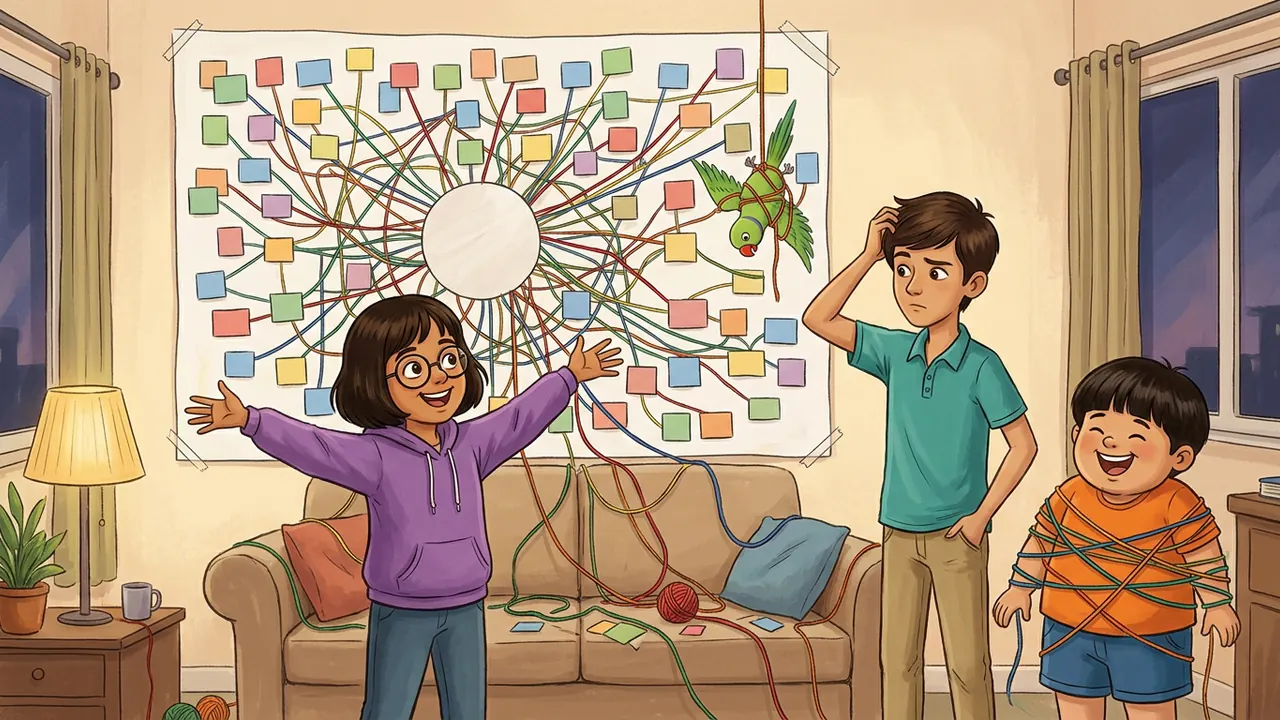
After Nandi Hills, Bunny’s paper neuron got only four Sundays wrong out of a hundred and fifty. Riya wanted zero. So she started adding clues. Lots of clues.
Did Prakash uncle wear his blue kurta? Was it an even-numbered date? Had Bharath anna’s scooter been washed? Did Happy have dosa or upma for breakfast? Each new clue got its own card, its own string and its own weight. Soon there were forty cards, then fifty, and the living room wall looked like a spider had lost its mind.
And then, one evening, Riya ran the last calculation and shouted, “ZERO! Not a single Sunday wrong! A hundred and fifty out of a hundred and fifty!”
Bunny looked at the wall doubtfully. “Riya, why does the scooter matter?”
“Who cares why? It works!”
Mitthu, who had flown into the strings and was now hanging upside down, said nothing. He was too busy trying to get his foot out of the dosa card.
Part 3 · The real exam
 Illustrated with AI
Then came the first real unit test.
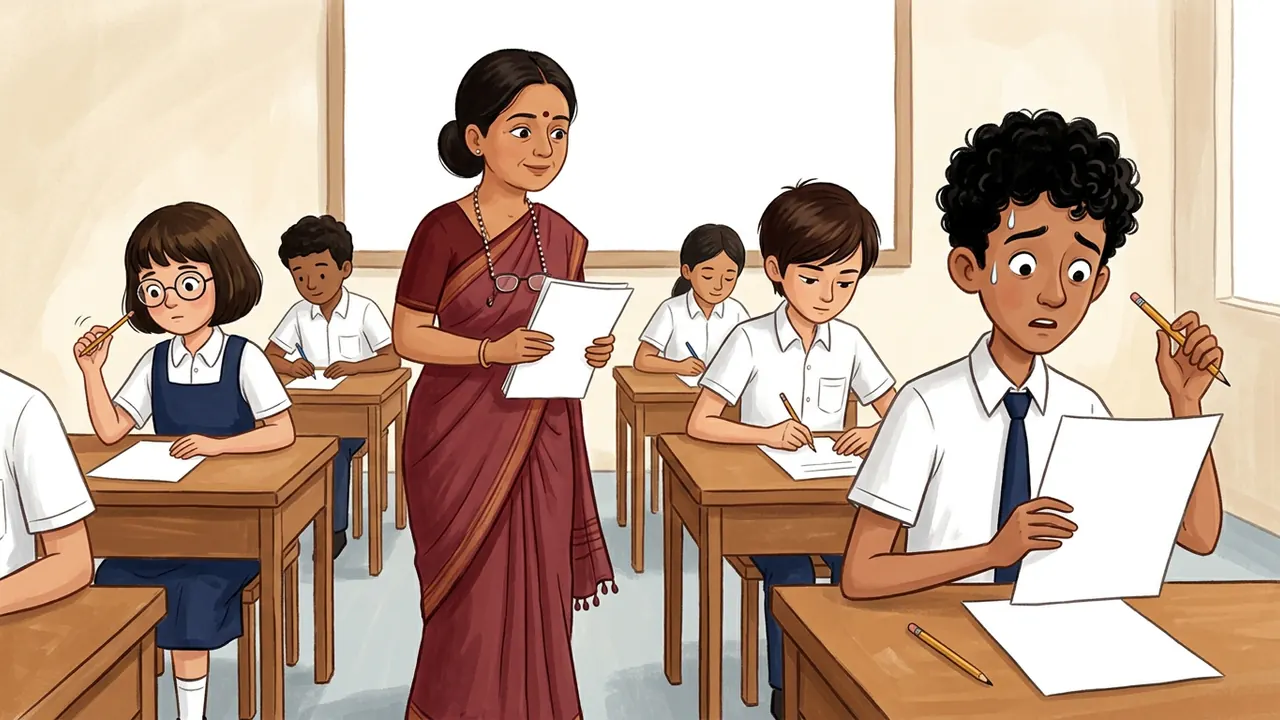
Bunny turned over his question paper. The first question was about the area of a triangle, the same kind as in last year’s paper, but with a garden instead of a flag, and with different numbers. The second was about speed, but the train was going to Mysuru instead of Chennai.
In the front row, Arjun had stopped writing. He read the first question again. And again. He knew the answer to last year’s question by heart: forty-two square centimetres. But this wasn’t last year’s question.
When the results came back, Arjun had scored thirty-eight. He sat very still and looked at the paper for a long time.
Lakshmi ma’am didn’t scold him. After class, she sat down next to him. “Arjun, you are a very hard worker,” she said gently. “But you learned the answers, not the way to get them. A practice paper you have already seen can’t tell either of us what you really know. That’s why the real exam always has new questions.”
Part 4 · Six new Sundays
That same month, Riya’s super neuron faced its own exam: six brand-new Sundays that weren’t in Prakash uncle’s notebook when she built it.
It got four of them wrong.
It said “play” on a Sunday of pouring rain, because Prakash uncle happened to be wearing his blue kurta, and in the old notebook, blue-kurta Sundays had always been sunny. It said “no match” on a perfect blue morning, because Happy had eaten upma.
Bunny’s simple neuron, with just five sensible clues, got five of the six right.
| Model | Old Sundays (the notebook) | Six new Sundays |
|---|---|---|
| Riya’s super neuron (50 clues) | 150 right out of 150 · 100% | 2 right out of 6 · 33% |
| Bunny’s neuron (5 clues) | 146 right out of 150 · 97% | 5 right out of 6 · 83% |
Riya stared at the numbers. “Mine was perfect,” she said quietly. “How can perfect be worse?”
Bunny thought of Arjun’s tower of papers. “Because yours wasn’t learning about cricket weather,” he said slowly. “It was learning those hundred and fifty Sundays by heart. Even the accidents. Like the kurta.”
Part 5 · The wiggly line
The next day, Riya and Bunny told Lakshmi ma’am the whole story. She smiled, picked up a piece of chalk, and drew a scatter of dots on the board.
“Here are some examples,” she said. “A model’s job is to draw a rule through them, so that when a new dot comes along, the rule can guess where it goes.”
She drew a flat straight line that missed most of the dots. “Too simple. This rule doesn’t even fit the examples it was given. That’s called underfitting.”
Then she drew a crazy wiggly line that twisted up and down to touch every single dot. “Too complicated. It fits every old dot perfectly, but look how it swings wildly in between. A new dot here, or here, and it’s badly wrong. That’s overfitting. It has memorised the examples, noise and accidents and all.”
Finally, she drew a smooth, gentle curve that passed close to most of the dots without touching all of them. “Just right. It has learned the pattern, not the dots. Scientists call that generalising.”
Lakshmi ma’am’s blackboard
The blue dots are the examples. The wiggly line touches every one, but would make big mistakes on any new dot in between.
Part 6 · Rattu tota
 Illustrated with AI
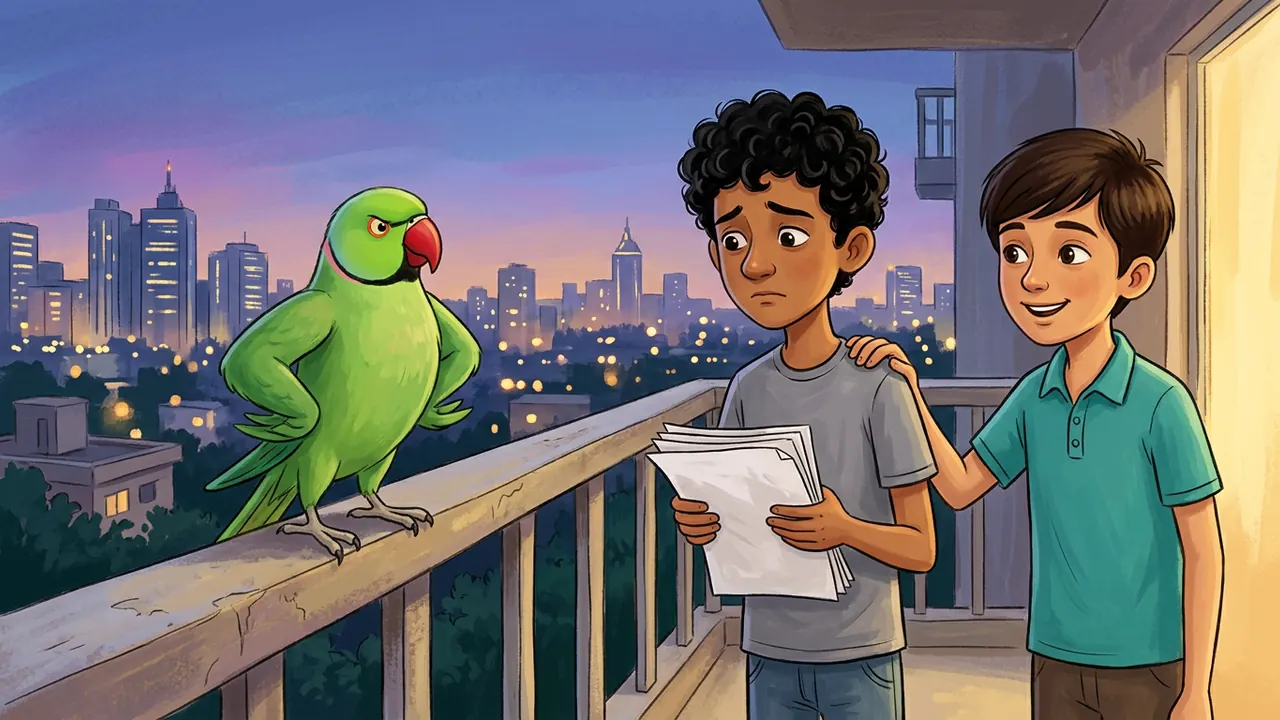
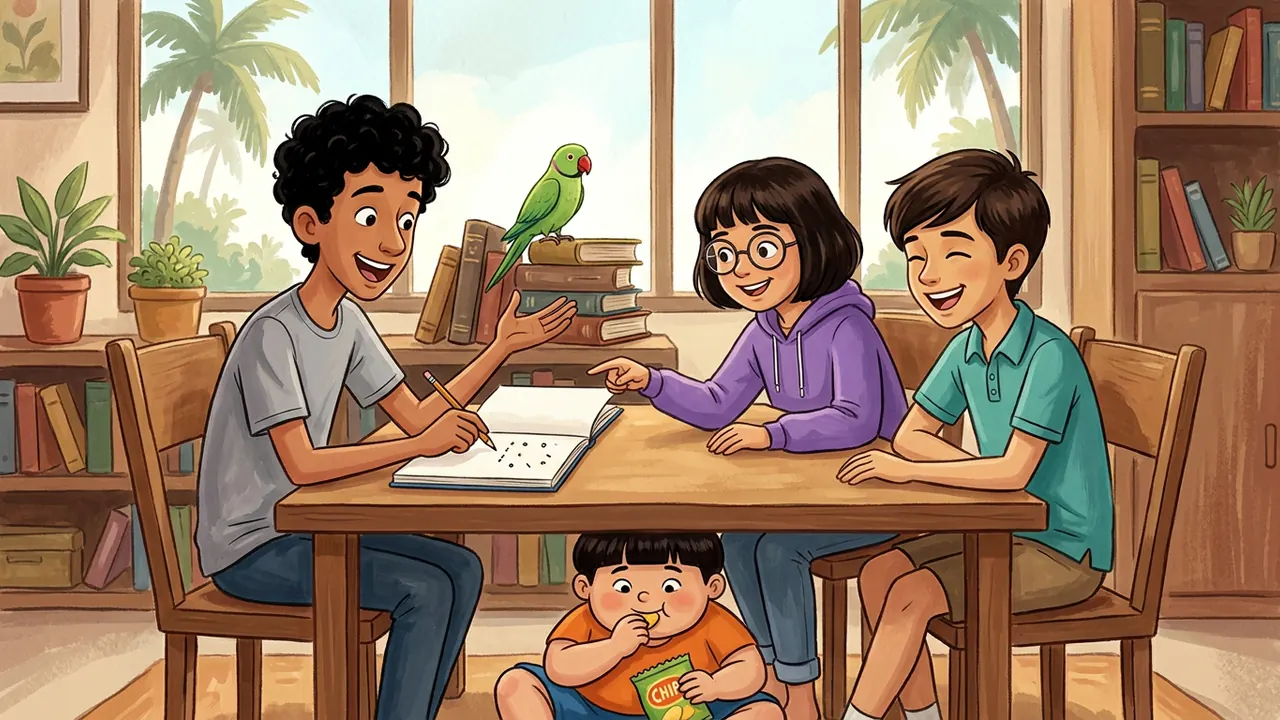
That evening, Bunny invited Arjun home. Arjun brought his tower of papers, and looked at them sadly.
“In my old school,” he said, “everyone called me a rattu tota. A parrot who only repeats what he has heard.”
From the balcony railing came a furious squawk. Mitthu puffed out every feather he had.
“Excuse me,” he said. “I am a parrot. And I will have you know that parrots are extremely intelligent birds.” He paused. “Although,” he admitted, “when I was young, I did once learn the whole of Dadi’s grocery list by heart. Every week I would shout ‘two kilos onions, one kilo dal!’, even when the onions were already in the kitchen.”
Arjun laughed for the first time that week.
“Memorising isn’t bad,” said Bunny. “You have to remember things to learn them. But then you have to understand why, so you can use it on something new.”
“Then teach me the why,” said Arjun. “And I’ll teach you something. My cousin in Pune works with AI. She says they never test a model on the examples it learned from. They hide some of the examples away first, and only use them at the very end. Like a sealed exam paper.”
Part 7 · The sealed envelope
 Illustrated with AI
So that’s what they did. Riya took Prakash uncle’s notebook and covered thirty of the hundred and fifty Sundays with paper, then sealed them in an envelope. “Nobody looks at these,” she said, “until the very end.”
They trained on the other hundred and twenty. Every time Riya wanted to add a new clue, they tested it, and only kept it if it helped on Sundays it hadn’t seen. The blue kurta went. The scooter went. The dosa card went, to Happy’s great disappointment.
When they finally opened the envelope, the neuron got twenty-eight of the thirty sealed Sundays right.
“Ninety-three percent,” said Riya, a little proudly, “on Sundays it had never seen. That’s a real score.”
And three weeks later, in the next unit test, Arjun got seventy-nine. Not a hundred. But every single mark was his own.
Mitthu, who had been listening from the top of a pile of books, nodded wisely. “Two kilos onions,” he muttered to himself, “only if there are no onions in the kitchen.”
Moral of the story
Understand, don’t just memorise. Knowing the answers to old questions is not the same as knowing how to answer new ones, and the only fair test is one you have never seen.
The parrot learned the list by heart,
but missed the reason, missed the art.
Learn the why, and not just what,
and new questions won’t tie a knot.
Mitthu’s notebook
What really happened?
| In the story | In machine learning |
|---|---|
| Last year’s papers, and the old Sundays in the notebook | Training data: the examples a model learns from |
| The real exam, and the six new Sundays | Test data: new examples the model has never seen |
| Arjun memorising answers, Riya’s 50-clue neuron | Overfitting: great on training data, poor on new data |
| A flat straight line that misses the dots | Underfitting: too simple even for the training data |
| The smooth “just right” curve | Generalising: learning the pattern, so it works on new examples |
| The blue kurta and the scooter | Spurious patterns: accidents in the data that look like rules |
| Thirty Sundays sealed in an envelope | A held-out test set, kept hidden until the very end |
Try it yourself
Too simple, just right, too wiggly
The blue dots are the training examples. Slide to let the rule bend more. Then tick Show the new dots to see the sealed test examples. Which setting does best on dots it has never seen?
Watch what happens at 9: the line touches every blue dot, so mistakes on old dots drop to zero, but mistakes on new dots shoot up.
Maths corner
The two scores that matter
Accuracy is just a percentage: the number right, divided by the total, times 100. A model always gets two scores: one on its training data, and one on test data it has never seen.
accuracy = (number right ÷ total) × 100
Riya’s super neuron: 150 ÷ 150 × 100 = 100% on training, but 2 ÷ 6 × 100 ≈ 33% on test. A big gap between the two scores is the classic warning sign of overfitting.
Your turn. A model gets 190 out of 200 training examples right, and 30 out of 50 test examples right. Work out both accuracies. Is it overfitting?
Answer: training 190 ÷ 200 = 95%, test 30 ÷ 50 = 60%. A 35-point gap means it has memorised much more than it has understood. Yes, it is overfitting.
Try it on a computer · optional
Watch a rule overfit, in Python
This uses the numpy library, which most free online Python editors already have. It fits rules of three different “bendiness” levels to 10 noisy training dots, then tests each one on 10 new dots.
import numpy as np
np.random.seed(1)

x = np.linspace(0, 1, 10)                         # training dots
y = np.sin(2*np.pi*x) + np.random.normal(0, 0.2, 10)
x_test = np.linspace(0.05, 0.95, 10)               # new dots
y_test = np.sin(2*np.pi*x_test)

for degree in [1, 3, 9]:
    rule = np.polyfit(x, y, degree)                  # learn a rule
    train_err = np.mean((np.polyval(rule, x) - y)**2)
    test_err  = np.mean((np.polyval(rule, x_test) - y_test)**2)
    print(degree, round(train_err, 3), round(test_err, 3))
1 0.233 0.208
3 0.054 0.022
9 0.0 2.857
Look at the last line. The bendiest rule has zero training error, but the biggest test error of all, more than a hundred times worse than the “just right” rule.
AI security tip
A model that memorises can leak
Riya’s super neuron memorised that Prakash uncle wore a blue kurta. Harmless. But big AI models can also memorise rare things from their training data, like someone’s phone number or address, and repeat them later to a stranger who asks the right question. That’s why careful engineers remove private information before training, and test whether a model will repeat things it should have forgotten.
Remember: anything you type into an AI app might one day become training data. Never share passwords, phone numbers or addresses with a chatbot.
Did you know?
Fun facts
Myth or fact?
“If a model gets 100% on its training data, it must be perfect.”
MythRiya’s super neuron got 100% on its training data and then failed on four of six new Sundays. A perfect training score can even be a warning sign. The score that matters is the one on data the model has never seen.
Try this · no computer needed
Memorisers vs Understanders
You need: two teams, five practice sums with answers, and five new sums of the same kind.
- The teacher hands out five practice sums, like “A rectangle is 4 m by 6 m. Find its area.”, with the answers.
- Team Memorise gets two minutes to learn the five answers by heart. Team Understand gets two minutes to work out how each answer was found.
- Test 1: the teacher asks the same five sums. Who wins?
- Test 2: the teacher asks five new sums of the same kind, with different numbers. Who wins now?
- Discuss: which test told you more about what each team really learned?
Careers corner
AI evaluation engineer
Evaluation engineers are the Lakshmi ma’ams of the AI world. Their job is to design fair tests for AI models: new questions the model has never seen, tricky cases, and checks for unfairness or leaked private data. A model doesn’t get released until it passes their exams.
Useful to learn: statistics, programming, careful record-keeping, and a talent for thinking up the question nobody else thought of.
Quiz time
How well did you learn?
Think and discuss
No wrong answers here
- Are there subjects where memorising is useful, like times tables or spellings? Where does understanding take over?
- Arjun scored 79 instead of 100, but Bunny thought it was a better result. Do you agree? Why?
- Riya’s neuron learned that the blue kurta meant sunshine. Can you think of a time a person believed a “rule” that was really just a coincidence?
- If a company only told you its AI’s training score, what question would you ask them?
Be curious
Ask a teacher, parent or engineer
Word bank
New words from this chapter
Coming up in Chapter 4
Happy tips a box of word cards in Kannada, Hindi and English all over the living room floor, and challenges everyone to arrange them. Somehow, “mango” ends up next to “maavina hannu” and “aam”, and Mitthu discovers that words have neighbours…
For teachers and parents: this chapter fits two 40-minute periods. Period 1: read Parts 1–7 aloud (18 min), discuss the results table and Lakshmi ma’am’s blackboard (10 min), then the Maths corner (10 min). Period 2: “Memorisers vs Understanders” in two teams, the interactive line-fitting game if devices are available, the quiz, and Think and Discuss. The key ideas: models must be judged on data they have not seen; overfitting means memorising training examples, including noise and coincidences; underfitting means the rule is too simple; a held-out test set gives an honest score; and models that memorise can leak private data. Please handle the “rattu tota” scene with care: the point is that memorising is a useful first step, not something to be mocked. The numbers in the Sunday results are part of the story. The Python corner is optional and needs numpy. The story illustrations marked “Illustrated with AI” were made with an AI image generator; the diagrams, tables and the line-fitting game were made by hand.