 Illustrated with AI
Jugnupur Tales · Volume 1 · Chapter 1
Mitthu and the Mango Mystery
Part 1 · The village of fireflies
Beside a slow green river there is a village called Jugnupur. On summer nights, so many fireflies (jugnu) glow in its mango trees that the whole village twinkles, like a piece of the sky that has come down to rest.
Every summer holiday, Jugnupur had a visitor who asked more questions than anyone in the village. His name was Bunny. He was ten years old and in Class 5. Bunny and his six-year-old brother Happy lived in Bengaluru with Mummy and Papa, but every summer they came to stay with their Dadi, next to the oldest mango orchard for miles around. It belonged to Dadi.
And on the lowest branch of the oldest tree lived Mitthu: a green parrot with a bright red beak and a very high opinion of himself.
Part 2 · One mango, one rule
 Illustrated with AI
One mango, one second, one rule. What could go wrong?
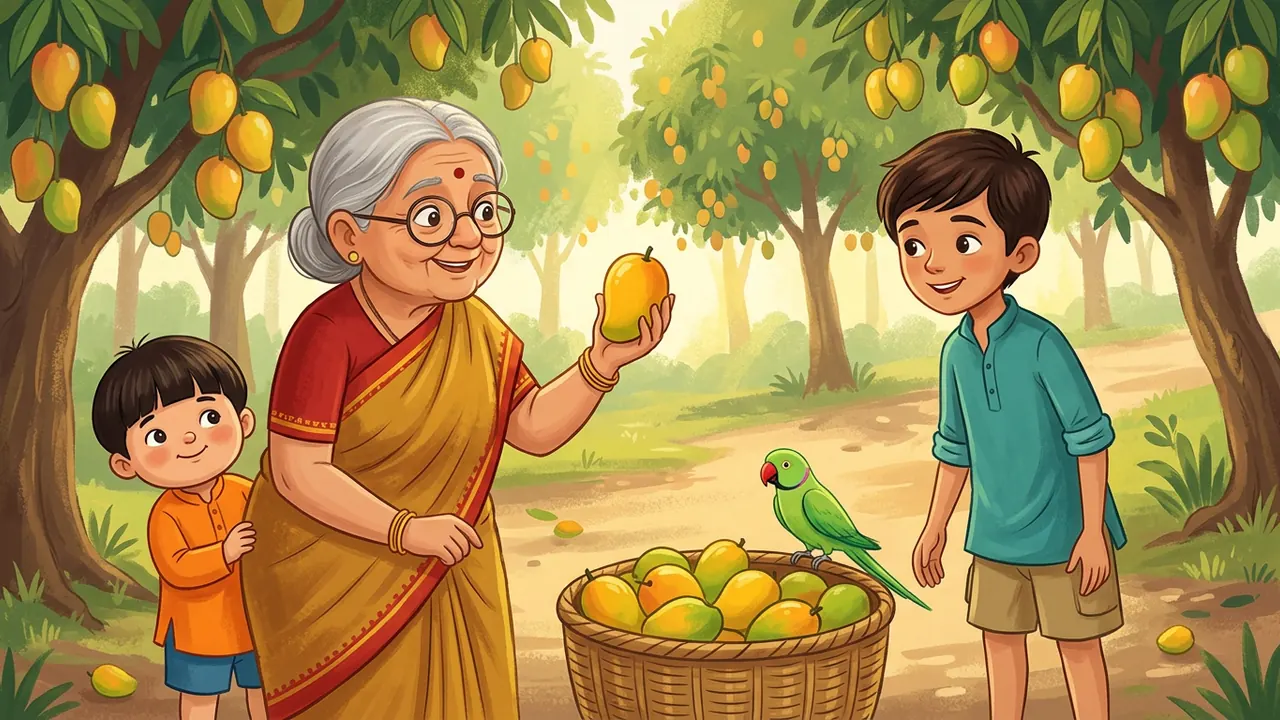
It was the busiest week of summer. “Tomorrow the cart goes to the mandi,” said Dadi, wiping her spectacles. “We must sort every mango tonight. Pakka ones, the ripe ones, go to the market. Kachcha ones, the raw ones, stay here to ripen, or they go into Dadi’s pickle.”
“Leave it to me!” squawked Mitthu, flapping down onto the basket. “I am the cleverest bird in Jugnupur.”
Dadi smiled and held up one mango. It was golden yellow, with a pink blush on one cheek. “This one is ripe,” she said.
Mitthu looked at it for exactly one second. “Yellow means ripe! Green means raw! Easy!”
Before anyone could say another word, he began. Yellow here. Green there. Yellow, yellow, green, yellow. By the time the first fireflies came out, every mango was sorted.
“See?” he said, puffing out his chest. “Finished before dinner.”
Part 3 · The morning of mistakes
 Illustrated with AI
The next morning, Ramesh bhaiya, who drove the mango cart, came back early. He did not look happy.
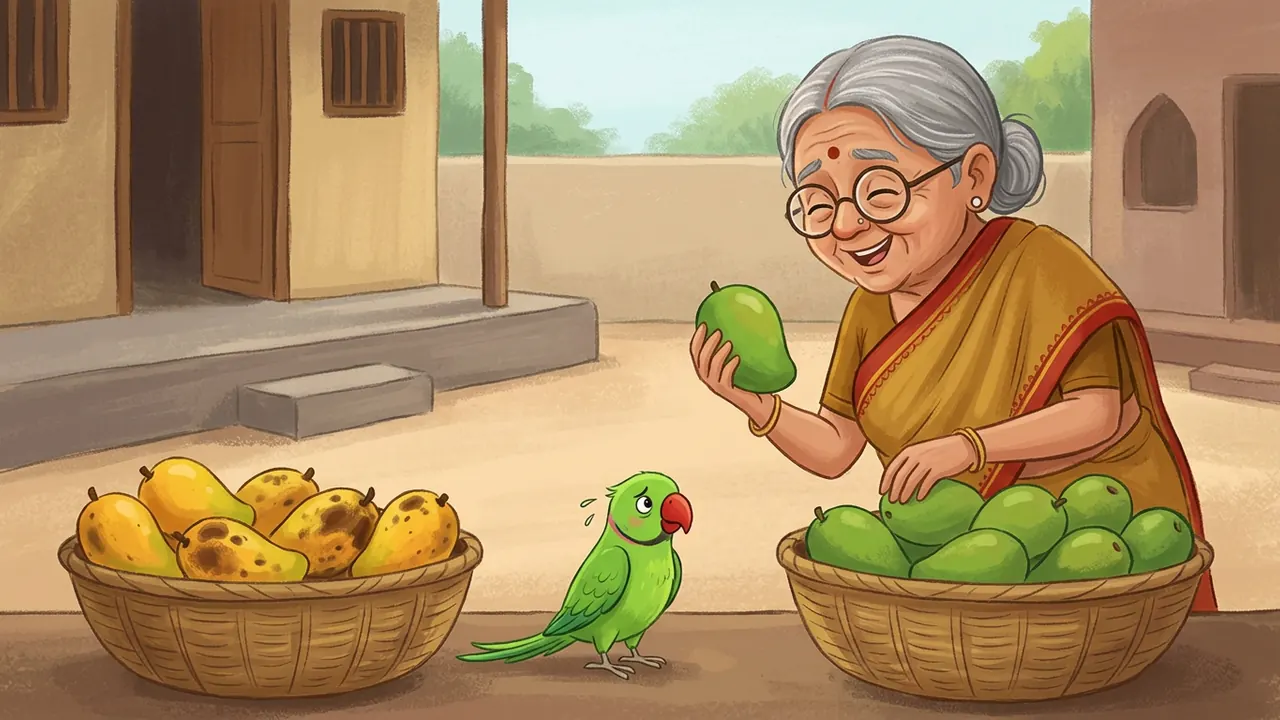
“Dadi, three customers came back to complain,” he said. “Some of the yellow mangoes were soft and brown inside, far too old to eat. And Sharma aunty asked why we didn’t bring any Langra this year. She says they are the sweetest of all.”
Dadi walked to the kachcha basket and picked up a green mango. She pressed it gently with her thumb. She sniffed it near the stem. Then she began to laugh.
“Mitthu,” she said, “these are Langra mangoes. A Langra stays green even when it is perfectly ripe.”
Mitthu’s feathers drooped. “But yellow means ripe. That was my rule.”
“You made a rule from one mango,” said Dadi kindly. “One mango cannot teach you about all mangoes.”
Part 4 · Learning from many
Bunny had an idea. “Mitthu, let’s play a game. I’ll show you mangoes one at a time. You guess: ripe or raw. Then I’ll tell you if you are right.”
They collected fifty mangoes of every kind they could find: round Dasheri, green Langra, long Totapuri with its pointed tip like a parrot’s beak, juicy Chausa, and a few that had been lying around for far too long.
In the first round of ten, Mitthu got six wrong. He grumbled. But every time he was wrong, Bunny said the same thing: “Look again. What is different about this one?”
So Mitthu began to notice things. He found four clues.
Colour
Helpful, but only if you know the variety. Langra fools you.
Smell
A ripe mango smells sweet near the stem. A sour smell means too old.
Softness
It gives a little when pressed gently. Not hard like a stone, not squishy like mud.
Shape & spots
Shape tells the variety. Brown spots and wrinkles mean trouble.
Round after round, his mistakes shrank. Six, then four, then three, then two, and finally just one.
Mitthu wasn’t following one rule anymore. He was checking many clues together, the way Dadi did without even thinking about it.
Mitthu’s mistakes, out of 10 mangoes
Part 5 · The real test
 Illustrated with AI
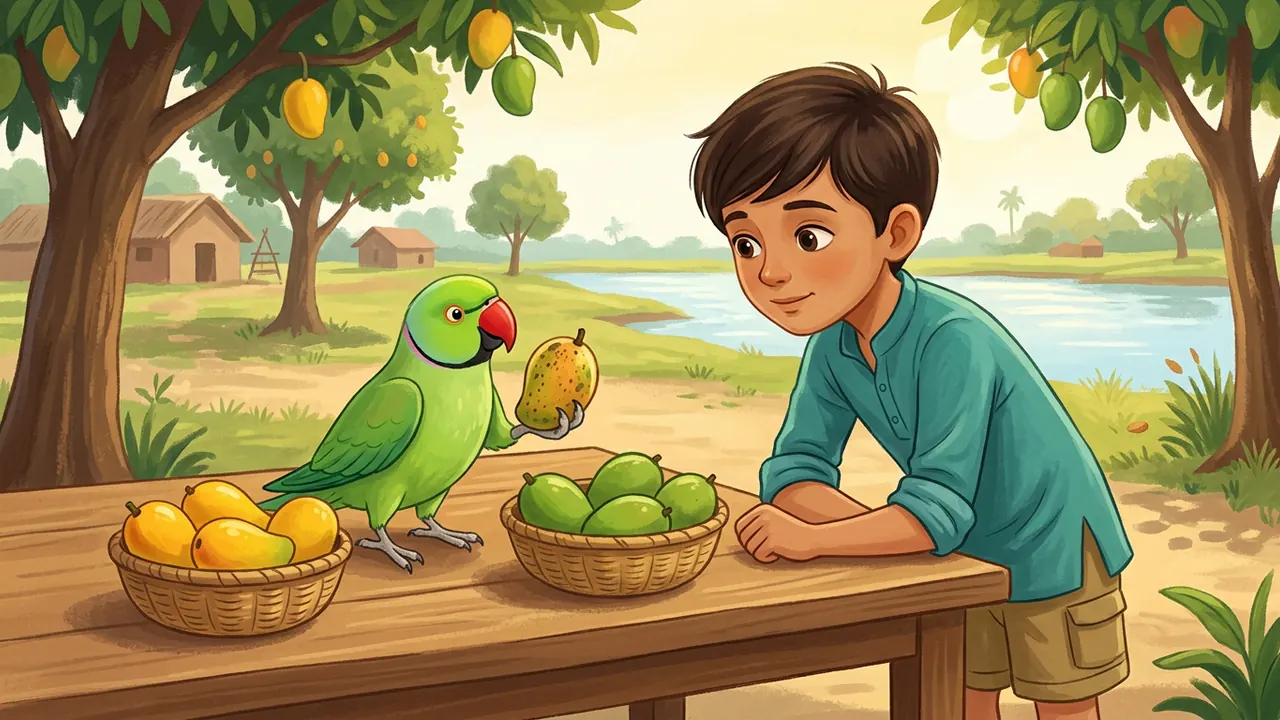
The next day, Farooq chacha came over from his farm across the river with a basket of his own mangoes. “Mitthu has never seen these,” Bunny whispered. “This is the real test.”
Mitthu sniffed near each stem. He pressed very gently with his claw. He looked at the colour and the shape. Pakka. Kachcha. Pakka. Pakka.
He got nine out of ten right. And when he came to one strange, speckled mango, he stopped.
“This one… I am not sure,” he said. “Bunny, can you check?”
Dadi clapped her hands. “Now that is a clever bird,” she said. “He knows what he knows, and he knows what he doesn’t.”
Part 6 · A call from Bengaluru
 Illustrated with AI
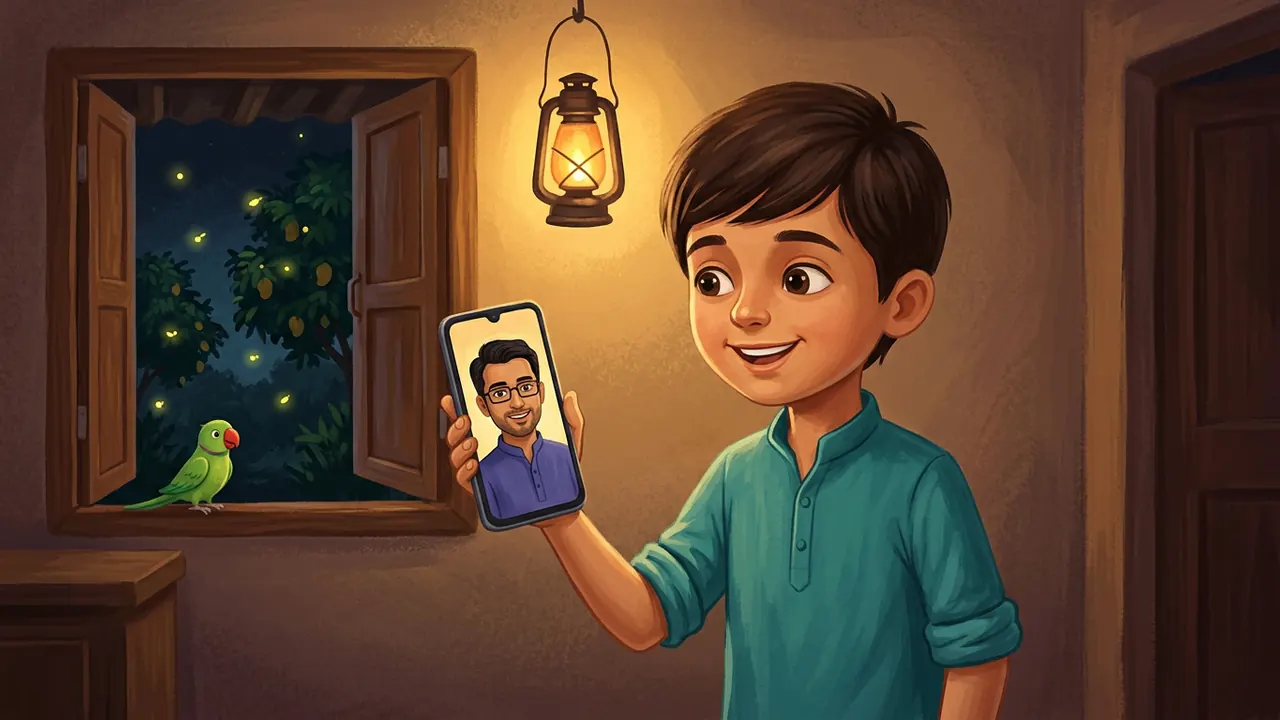
That night, Bunny’s uncle, Kabir chachu, called from Bengaluru, where he works as an engineer who builds AI. Bunny told him the whole story.
Chachu grinned. “Bunny, Mitthu just learned in the same way many AI programs learn!”
“A parrot is like a computer?”
“In one way, yes. Nobody writes one simple rule like ‘yellow means ripe’ inside an AI. Instead, we show it thousands of examples, each with the right answer. It guesses, it checks, it adjusts, again and again, until it gets good at spotting patterns. Then we test it on examples it has never seen before. Just like Farooq chacha’s basket.”
“Like the plant app on your phone!” said Bunny. “You point the camera at a leaf and it says ‘Neem’.”
“Exactly. That app learned from a huge number of leaf photos. And a good AI, like a good parrot, should tell you when it is not sure.”
Bunny looked out of the window. The fireflies were blinking over the mango trees. So AI isn’t magic, he thought. It’s learning. From lots of examples, and lots of mistakes.
Moral of the story
One mango cannot teach you about all mangoes. Learn from many examples, learn from your mistakes, and be brave enough to say “I am not sure.”
From one small fruit, a rule is weak;
from many, the wise find what they seek.
Each mistake is a friend who shows the way,
so guess, and check, and learn each day.
Mitthu’s notebook
What really happened?
Everything Mitthu did has a name in the world of AI. Here is the story, translated.
| In the story | In AI, we call it | What it means |
|---|---|---|
| The fifty mangoes Mitthu practised with | Training data | The examples a computer learns from. |
| Bunny saying “ripe” or “raw” for each one | Labels | The correct answer attached to each example. |
| Colour, smell, softness, shape | Features | The clues the computer looks at to decide. |
| “Look again. What is different?” | Feedback | Finding out you were wrong, so you can adjust. |
| Checking many clues together | A pattern | What the learner discovers from lots of examples. |
| Farooq chacha’s basket | Test data | New examples it has never seen, to check if it really learned. |
| “Pakka!” for each new mango | A prediction | The computer’s best guess. |
| “This one… I’m not sure” | Confidence | How sure the computer is about its guess. |
| “Yellow means ripe” from one mango | Over-simple rule | Learning from too few examples, so the rule breaks on new ones. |
The learning loop
Did you know?
Fun facts
Try this · no computer needed
Be the Machine
You need: a partner, and about 20 leaves from two different kinds of trees (or 20 picture cards of two kinds of animals). Time: 20 minutes.
- One of you is the Teacher. The other is the Machine.
- Round A: The Teacher shows the Machine just one leaf of each kind and says its name. The Machine makes a rule, like Mitthu did.
- The Teacher shows 8 new leaves, one at a time. The Machine guesses each one. Count the mistakes.
- Round B: Now the Teacher shows 5 leaves of each kind, with names. The Machine may look closely at edges, colour, size and veins.
- Test again with leaves the Machine has not seen before. Count the mistakes.
- Talk about it: which round had fewer mistakes? Which clues helped most? Did the Machine ever want to say “I’m not sure”?
Quiz time
How well did you learn?
Think and discuss
No wrong answers here
- Mitthu used smell and softness. A computer has no nose or fingers. What could it use instead to tell if a mango is ripe?
- What if Mitthu had practised only with Dadi’s Dasheri mangoes? What might go wrong with Farooq chacha’s basket?
- Where have you seen a machine make a guess? Think about your phone’s keyboard, a video app, or a map.
- Why is it a good thing when an AI says “I’m not sure”?
Be curious
Ask a teacher, parent or engineer
Word bank
New words from this chapter
Coming up in Chapter 2
What happens when a learner only ever sees one kind of example? Mitthu is about to find out.
For teachers and parents: this chapter fits two 35-minute periods. Period 1: read Parts 1–6 aloud (15 min), go through Mitthu’s Notebook (10 min), do the quiz (10 min). Period 2: “Be the Machine” and the Think and Discuss questions. The key idea to leave with children is that AI learns patterns from many labelled examples and gets better through feedback, and that it can still be wrong. The story illustrations marked “Illustrated with AI” were made with an AI image generator; the diagrams, charts and labelled scenes were drawn by hand.