 Illustrated with AI
Jugnupur Tales · Volume 1 · Chapter 2
The Judge Who Never Crossed the River
Part 1 · The Mango Mela
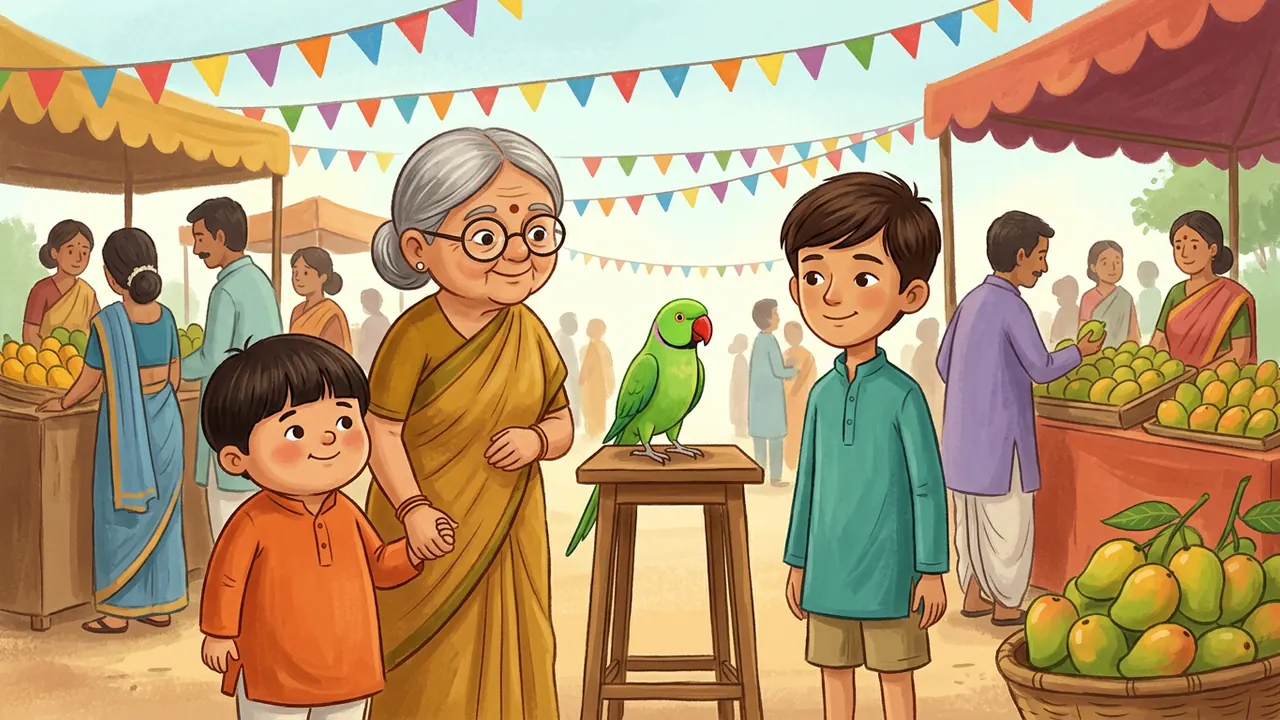
Every year, when the mangoes are at their sweetest, Jugnupur holds its Aam Mela, the mango fair. Farmers come from villages near and far. There are bright flags, sugarcane juice, a giant jhoola, and mangoes piled so high that even the air smells sweet.
This year there was something new. The story of the mango mystery had spread all over the village, so the Mela committee made an announcement: “Our judge for ripe mangoes this year will be… Mitthu the parrot!”
Mitthu sat on a wooden stand marked JUDGE, his feathers fluffed up, looking very important indeed. Bunny and Dadi stood close by, feeling proud.
Farmer after farmer brought their baskets. Mitthu sniffed near the stems, pressed gently, and looked at colour and shape. “Pakka! Kachcha! Pakka!” He was quick, and he was right. The crowd cheered every time.
Part 2 · The basket from the hills
 Illustrated with AI
Mitthu had never seen a mango like this before. He guessed anyway.
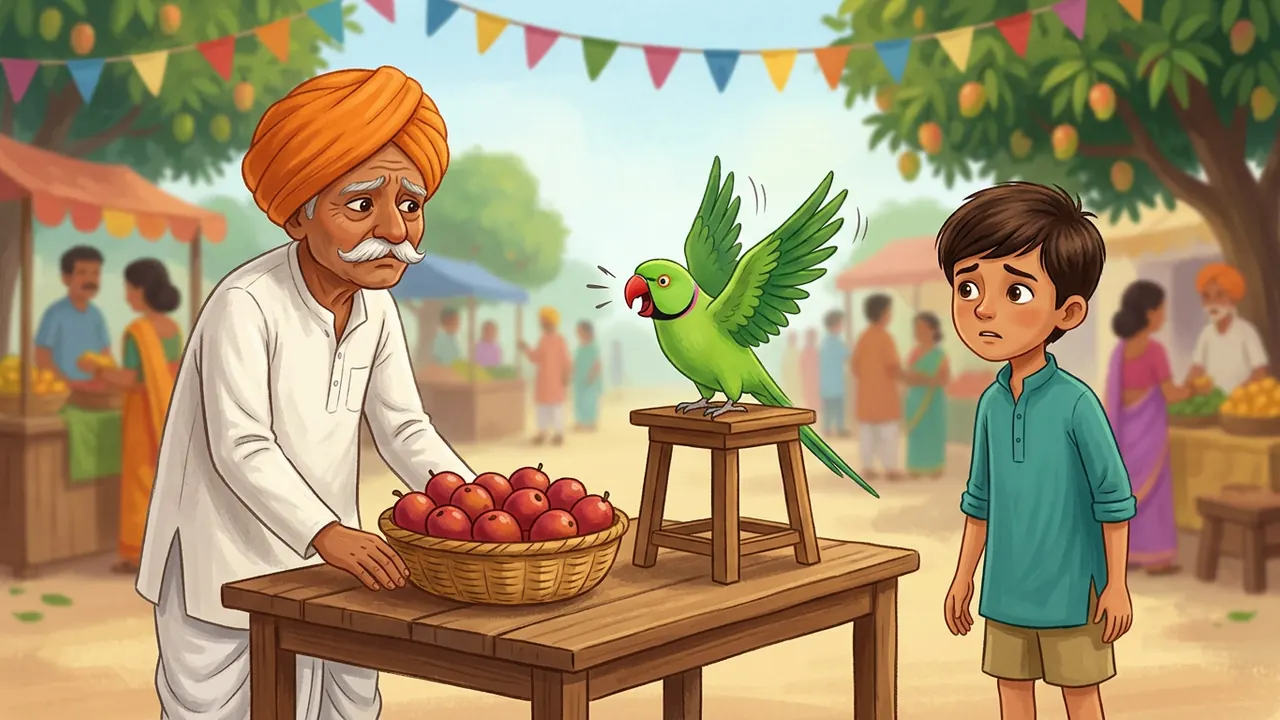
In the afternoon, an old farmer walked slowly up to the stand. He wore a bright orange pagdi, with a red gamchha over his shoulder, and he had been walking since sunrise.
“Namaste. I am Bhola, from Pahadpur, up in the hills across the river,” he said, setting down his basket. “These are our Lal Moti mangoes.”
The mangoes were small, round and deep red. Mitthu had never seen anything like them. He pressed one. Firm. He sniffed it. Not the sweet smell he knew.
“Raw!” he announced. “All raw! Next!”
Bhola kaka’s face fell. “But I picked them this morning, at exactly the right time,” he said quietly. “In Pahadpur, everyone knows that Lal Moti stays firm even when it is ripe.”
But the judge had spoken. The committee put his basket aside. Without a “ripe” mark, no shopkeeper would buy his mangoes. Bhola kaka sat down under a tree, his long walk wasted.
Bunny frowned. Something did not feel right.
Part 3 · Bunny counts
That evening, Bunny opened his notebook. In it he had drawn every one of the fifty mangoes Mitthu practised with.
He counted. Dasheri, Langra, Totapuri, Chausa… every single mango came from Dadi’s orchard. From Jugnupur: fifty. From the hills: zero.
“Mitthu,” he said slowly, “you didn’t get Bhola kaka’s mangoes wrong because you are a bad judge. You got them wrong because you had never seen one.”
Mitthu hung his head. “My clues only work for the mangoes I learned from. For hill mangoes, my clues were wrong.”
“And it wasn’t fair,” said Bunny. “Bhola kaka lost his whole day, and maybe his money, because of what was missing from your practice pile.”
Dadi put down her cup of tea. “A judge who learns from only one kind will be unfair to every other kind,” she said. “It is not because he has a bad heart. It is because of the examples he never saw. But a mistake like this must still be put right.”
Part 4 · Across the river
 Illustrated with AI
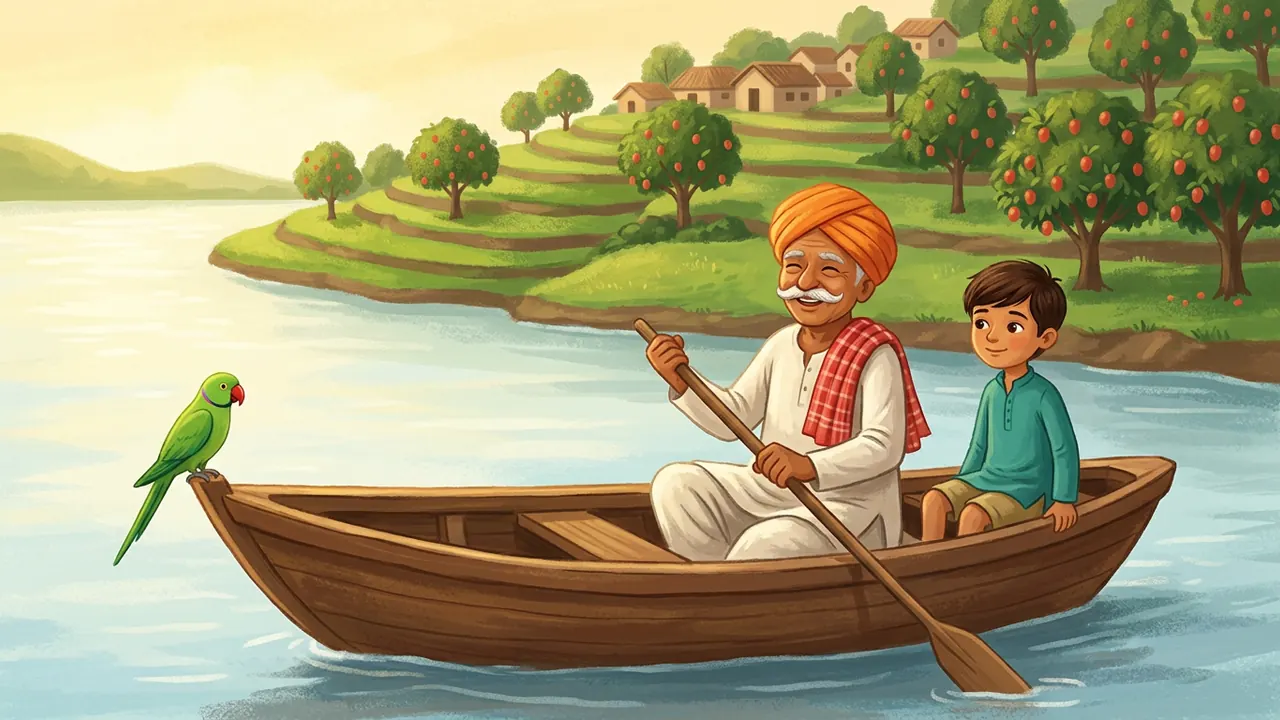
Early next morning, Bunny, Mitthu and Dadi found Bhola kaka at the ghat, getting his boat ready to go home. “Kaka,” said Bunny, “will you teach Mitthu about your mangoes?”
For the first time since the Mela, Bhola kaka smiled. They climbed into his little boat and crossed the river to Pahadpur.
There, among the green terraced hills, the farmers showed Mitthu forty Lal Moti mangoes: ripe ones and raw ones, big ones and small ones. Mitthu learned new clues. A ripe Lal Moti is red all over, with no green patch near the stem. Its skin is shiny. And it has a light, flowery smell, very different from Dadi’s mangoes.
Then Mitthu practised, round after round, just as he had with Bunny before. Guess. Check. Adjust. Again.
Part 5 · Judging again
Back at the Mela, the committee agreed to judge Bhola kaka’s basket again. This time, Dadi and two Pahadpur farmers stood beside Mitthu to check his answers.
Bunny also had a new idea. “Let’s test Mitthu on each kind of mango separately,” he said. “Otherwise a good score on Jugnupur mangoes could hide a bad score on hill mangoes.”
On Jugnupur mangoes, Mitthu still got nine out of ten right. On Pahadpur mangoes, he had got only three right at the Mela. Now he got eight.
Mitthu’s correct answers, out of 10, for each kind
“Pakka. Pakka. Pakka.” Most of Bhola kaka’s basket got its ripe mark, and a shopkeeper bought every mango by evening. And when the Mela ended, Lal Moti won the prize for the sweetest mango of the year.
“I am sorry, kaka,” said Mitthu. “Next time I meet something new, I won’t pretend. I’ll say, ‘I have not seen this kind before.’”
Part 6 · A call from Bengaluru
 Illustrated with AI
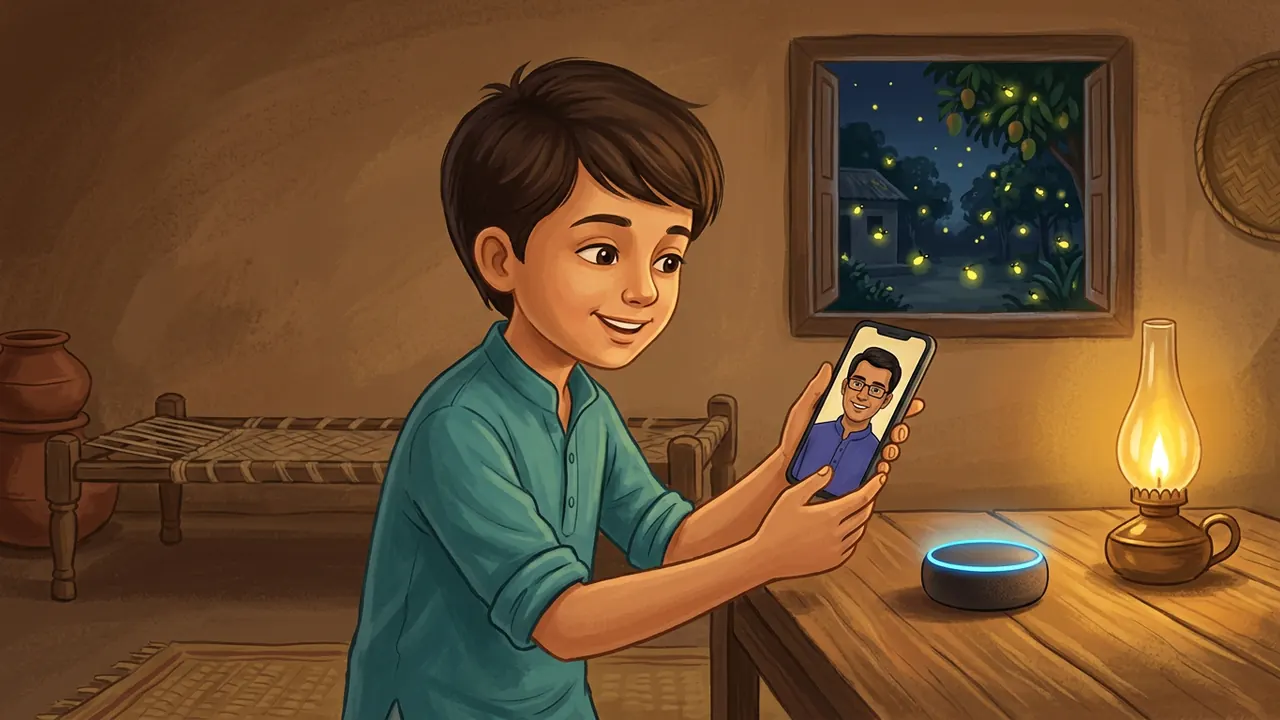
That night, Bunny told Kabir chachu everything.
“Bunny, what happened to Bhola kaka happens with AI too,” he said. “Engineers call it bias. An AI learns only from its examples. If most of its examples come from one kind of people, one place, or one way of speaking, it can work well for them and badly for everyone else.”
“Like what?”
“Like a voice assistant that learned mostly from one accent. It may find it harder to understand people who speak differently, even when they are saying exactly the same words.”
“That’s not fair!”
“No, it isn’t. So good engineers do what you did. They count what is in the data. They look for who is missing. They collect examples from them. They test the AI on each group separately. And for important decisions, they make sure a person checks the answer.”
After the call, Bunny looked out at the fireflies over the orchard. Some blinked fast, some slow, some bright, some soft. A fair judge, he thought, has to learn from all of them.
Moral of the story
A judge who has seen only one kind will be unfair to every other kind. Before you judge, ask yourself: have I seen enough of this kind?
Who learns from just one side of the stream
sees only half of what things seem.
So cross the river, meet the rest:
to learn from all is to learn best.
Mitthu’s notebook
What really happened?
Here is Chapter 2, translated into the language of AI.
| In the story | In AI, we call it | What it means |
|---|---|---|
| Mitthu’s 50 practice mangoes, all from one orchard | Unbalanced data | Examples that come mostly from one group, place or kind. |
| Calling ripe hill mangoes “raw” | Bias | An AI that is regularly wrong, or unfair, for one group. |
| Bhola kaka losing his sale | Real-world harm | AI mistakes can hurt real people, not just scores. |
| Bunny counting his notebook | Checking the data | Looking at what is in the examples, and what is missing. |
| Learning from 40 Lal Moti mangoes | Diverse data | Adding examples from every group the AI will meet. |
| Testing each kind separately | Fairness testing | Checking results for every group, so one good score can’t hide a bad one. |
| Dadi and the farmers checking answers | Human review | People checking an AI’s important decisions. |
| “I have not seen this kind before” | Knowing its limits | A good AI should warn you when something is new to it. |
Is the data balanced?
Did you know?
Fun facts
Try this · no computer needed
Draw a Shoe
You need: 5 or more friends, paper and pencils. Time: 20 minutes.
- Everyone gets one minute to draw “a shoe”. Don’t look at each other’s drawings!
- Put all the drawings together. This pile is your training data.
- Count the kinds: how many sports shoes, school shoes, chappals, juttis, Kolhapuris, sandals, gumboots?
- Imagine a machine that learned “shoe” only from your pile. Which kinds of shoes might it fail to recognise?
- Who would be treated unfairly if that machine decided who was “wearing shoes” at a school gate?
- Now fix it: draw the missing kinds and add them to the pile. Count again. Is it more balanced now?
Quiz time
How well did you learn?
Think and discuss
No wrong answers here
- Was it only Mitthu’s fault? Who else could have noticed the problem before the Mela?
- If a learning app learned only from students in big cities, whom might it misunderstand?
- Think of one thing about you, like your language, handwriting or festivals, that an AI might not have seen enough examples of.
- Should a machine alone decide important things, like who wins a prize or who gets a scholarship? Why should a person check?
Be curious
Ask a teacher, parent or engineer
Word bank
New words from this chapter
Coming up in Chapter 3
Mitthu finds a big pile of mystery objects, and nobody tells him what any of them are. Can he still learn something?
For teachers and parents: this chapter fits two 35-minute periods. Period 1: read Parts 1–6 aloud (15 min), go through Mitthu’s Notebook and the balance-scale picture (10 min), do the quiz (10 min). Period 2: “Draw a Shoe” and the Think and Discuss questions. The key idea to leave with children is that AI reflects the examples it learns from, so missing groups lead to unfair results. People can find and fix this by checking the data, adding what is missing, and testing for each group. The story illustrations marked “Illustrated with AI” were made with an AI image generator; the diagrams, charts and labelled scenes were drawn by hand.