 Illustrated with AI
Jugnupur Tales · Volume 1 · Chapter 3
The Heap With No Names
Part 1 · The old trunk
It was the week before Diwali, and all of Jugnupur was cleaning. Walls were whitewashed, doorways wore fresh torans of mango leaves and marigolds, and every house smelled of new paint and old dust.
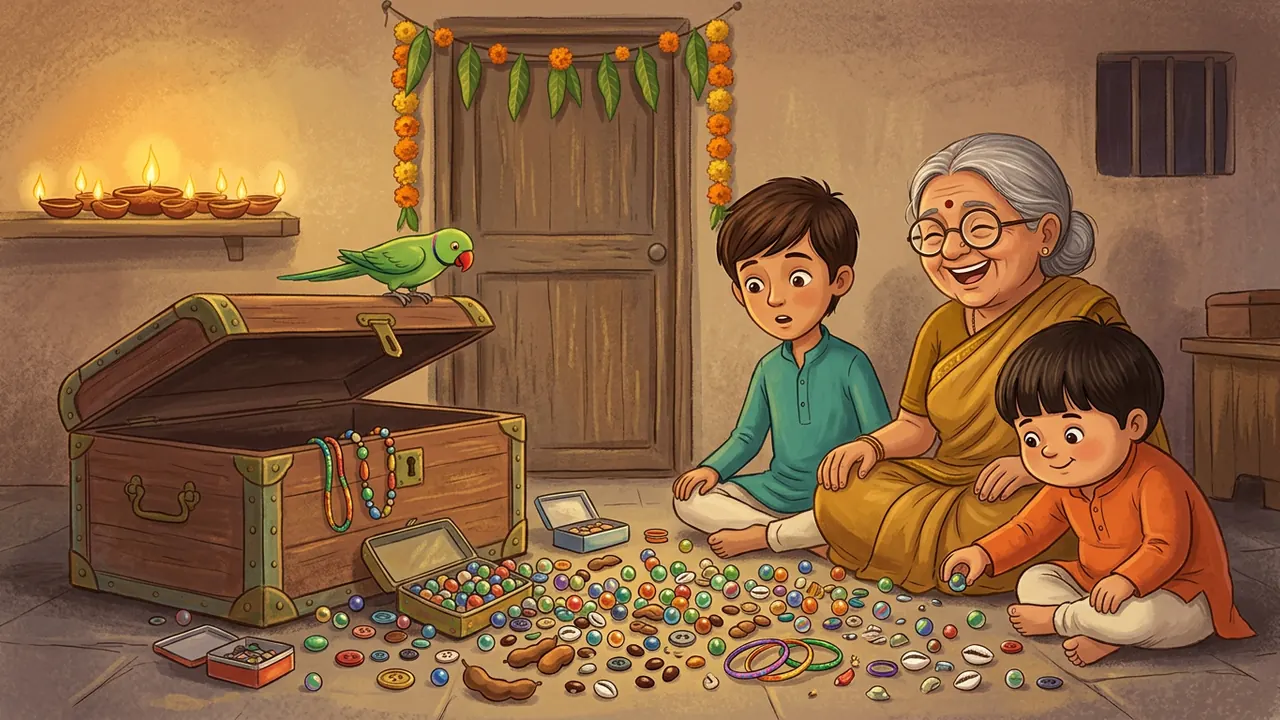
This year, Dadi’s job was the storeroom. Right at the back, under a pile of old quilts, stood a huge wooden trunk with brass corners. “My sandook,” said Dadi. “I haven’t opened it in years.”
Bunny and Dadi pulled. The lid creaked open, and then… CRASH! The trunk tipped over. Out tumbled dozens of little tin boxes. Their lids popped off, and hundreds of tiny things poured across the floor in one big, glittering heap.
Dadi sat down and laughed. “Forty years of little things,” she said. “Half of them, I don’t even remember what they are.”
Part 2 · A heap with no names
Mitthu hopped down from the trunk. “I’ll sort it!”
“Dadi, can you tell him what each thing is?” asked Bunny.
Dadi shook her head. “My eyes are tired tonight, beta, and I don’t have my spectacles. You’ll have to manage without me.”
Bunny looked worried. “Mitthu, with the mangoes, I told you ‘ripe’ or ‘raw’ every single time. Here, nobody can tell you the right answers.”
Mitthu tilted his head. “Then I won’t try to name things. I’ll just put things that are alike together.”
He began to look very closely. Big or small? Round or long? Smooth or bumpy? Does it roll? Does it have holes? Is it light or heavy?
Slowly, piles began to grow. By the time the evening lamps were lit, there were five of them. Mitthu didn’t know what anything was called, so he described each pile instead.
Mitthu didn’t know any names. He only knew what looked alike.
Part 3 · Bunny’s way
Bunny had been making his own piles in the corner. “Look, Mitthu! I sorted them too.”
His piles looked completely different. There was a red pile, a white pile, a brown pile and a blue-and-green pile. In his red pile, round see-through things, flat things with holes and curved pieces were all mixed up together, as long as they were red.
“That’s wrong!” squawked Mitthu. “You’ve mixed everything up!”
“It’s not wrong,” said Bunny. “I sorted by colour. You sorted by shape.”
They both looked at Dadi.
“You are both right,” said Dadi. “It depends on which clues you choose. If I want to put things back in their boxes, Mitthu’s piles are better. If I want to make a colourful border for my Diwali rangoli, Bunny’s piles are perfect.”
Mitthu thought about that. Same heap. Different clues. Different groups.
Part 4 · The odd one out
But one thing had not gone into any of Mitthu’s piles. It sat all by itself: flat, round, dull, and much heavier than anything else. It didn’t roll like Pile A. It had no holes like Pile B. It wasn’t shiny like Pile C.
“This one doesn’t fit anywhere,” said Mitthu. “It’s not like anything else in the whole heap.”
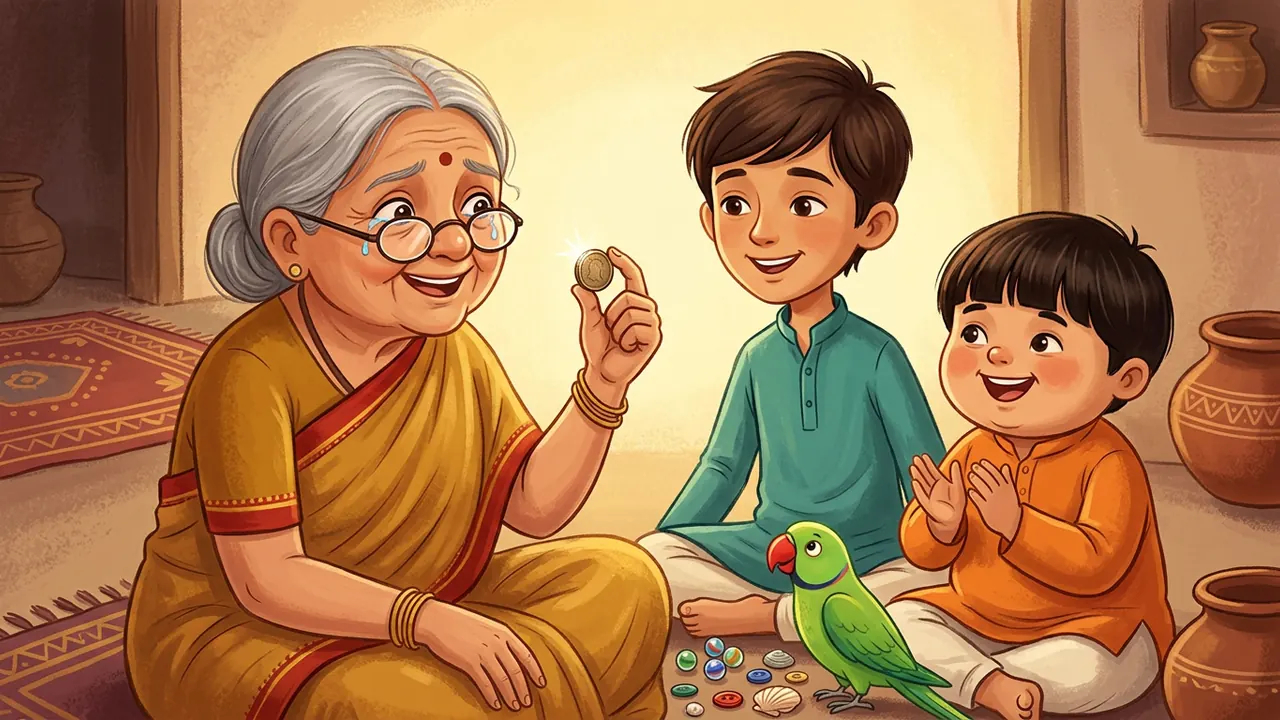
Dadi picked it up. She rubbed it on the end of her saree until it gleamed. Then her eyes filled with happy tears.
 Illustrated with AI
“This is my father’s coin,” she whispered. “An old one-anna coin, from before India changed to rupees and paise. He gave it to me on my wedding day. I lost it thirty years ago. I thought it was gone forever.”
Bunny hugged her. Mitthu fluffed up his feathers. “So the one that doesn’t fit anywhere… can be the most important one of all?”
“Sometimes,” said Dadi. “When something is very different from everything else, always take a closer look. It might be a treasure. Or it might be a problem.”
Part 5 · Giving the piles their names
The next morning, with her spectacles on and the sun shining through the window, Dadi looked at Mitthu’s piles one by one.
“Pile A: those are kanche, glass marbles. Your Papa played with them as a boy. Pile B: buttons, from old kurtas. Pile C: imli seeds. Your great-grandmother used them as counters for games. Pile D: kaudi, cowrie shells, for playing chauka-bara. And Pile E: pieces of broken glass bangles. Careful, those are sharp!”
Bunny wrote a label for each jar.
“Mitthu,” he said, “you found the groups all by yourself. Dadi only had to name five piles, instead of hundreds of tiny things.”
Part 6 · A call from Bengaluru
That night, Bunny told Kabir chachu about the heap, the jars and the coin.
“Bunny, what Mitthu did has a name,” said chachu. “It’s called unsupervised learning. With the mangoes, you gave him the right answer every time. That was supervised learning. But most of the world’s information comes with no answers at all. So we let computers find groups of similar things on their own. That’s called clustering.”
“Where do people use it?”
“Everywhere! Online shops find groups of shoppers who like similar things. Music apps can group songs that sound alike. Scientists use it to group stars that behave in similar ways.”
“And Dadi’s coin?”
“That’s called an anomaly: something that doesn’t fit the usual pattern. Banks use AI to notice a payment that looks very different from your usual ones, so they can check with you before any money is lost.”
“And people still have to name the groups,” said Bunny, “like Dadi did.”
“Exactly. The computer finds the groups. People decide what they mean.”
After the call, Bunny looked out of the window. The fireflies weren’t spread out evenly. They gathered in little groups: some by the pond, some around the mango trees, some near the well. Even fireflies make clusters, he thought, and smiled.
Moral of the story
Even when nobody gives you the answers, you can find order by noticing what is alike and what is different. And when something fits nowhere, look closer: it may be a treasure.
When no one tells you what things are,
look close, and compare them, near and far.
Put like with like, and soon you’ll see,
the odd one out may a treasure be.
Mitthu’s notebook
What really happened?
Here is Chapter 3, translated into the language of AI.
| In the story | In AI, we call it | What it means |
|---|---|---|
| The heap that nobody could name | Unlabelled data | Examples that come without any right answers. |
| Sorting without anyone saying “right” or “wrong” | Unsupervised learning | Learning by finding patterns on your own. |
| Putting alike things together | Clustering | Making groups of things that are similar. |
| Big or small, round or long, holes, weight | Features | The clues used to decide what is similar. |
| Mitthu’s piles vs Bunny’s piles | Choosing features | Different clues give different groups. Neither is “the” answer. |
| The coin that fit nowhere | Anomaly (outlier) | Something very different from the rest. Worth a closer look. |
| Dadi naming the piles | Human interpretation | People decide what the groups mean. |
| Chapter 1’s mangoes, with Bunny’s answers | Supervised learning | Learning from examples that come with right answers. |
Mitthu’s map of the heap
Each dot is one object from the heap. Nobody labelled the dots. The groups appear just by looking at which dots sit close together.
Two ways to learn
Did you know?
Fun facts
Try this · no computer needed
The Mystery Box
You need: 25 to 30 small objects from home or class (buttons, bottle caps, erasers, leaves, pencil stubs, seeds, keys), two teams and a table. Time: 25 minutes.
- Mix everything into one heap. No names allowed: you can only describe things.
- Team 1 sorts the heap into groups using any clues they like. Write a short description for each group, like Mitthu did.
- Mix the heap again. Team 2 must sort it using different clues from Team 1.
- Compare. How many groups did each team make? Which clues did they use?
- Find the odd one out: is there one object that fits no group? Is it a treasure or a problem?
- Only now, give each group a name. Was it easier to name groups than to name every single object?
Quiz time
How well did you learn?
Think and discuss
No wrong answers here
- Group your classmates using one clue (month of birthday, favourite subject, how they come to school). Then try another clue. Did the groups change?
- Is there always one right way to group things? When might one way be better than another?
- The odd one out can be a treasure or a problem. Can you think of one example of each?
- Why is it important that people, not just computers, decide what the groups mean?
Be curious
Ask a teacher, parent or engineer
Word bank
New words from this chapter
Coming up in Chapter 4
On Diwali night, Dadi tells her favourite story, and Mitthu starts guessing the next word before she says it. How does he do it?
For teachers and parents: this chapter fits two 35-minute periods. Period 1: read Parts 1–6 aloud (15 min), go through Mitthu’s Notebook and the “map of the heap” (10 min), do the quiz (10 min). Period 2: “The Mystery Box” and the Think and Discuss questions. The key ideas: computers can find groups in data that has no labels (clustering); the clues chosen change the groups; things that fit no group (anomalies) deserve a closer look; and people give the groups meaning. The story illustrations marked “Illustrated with AI” were made with an AI image generator; the diagrams, charts and labelled scenes were drawn by hand.